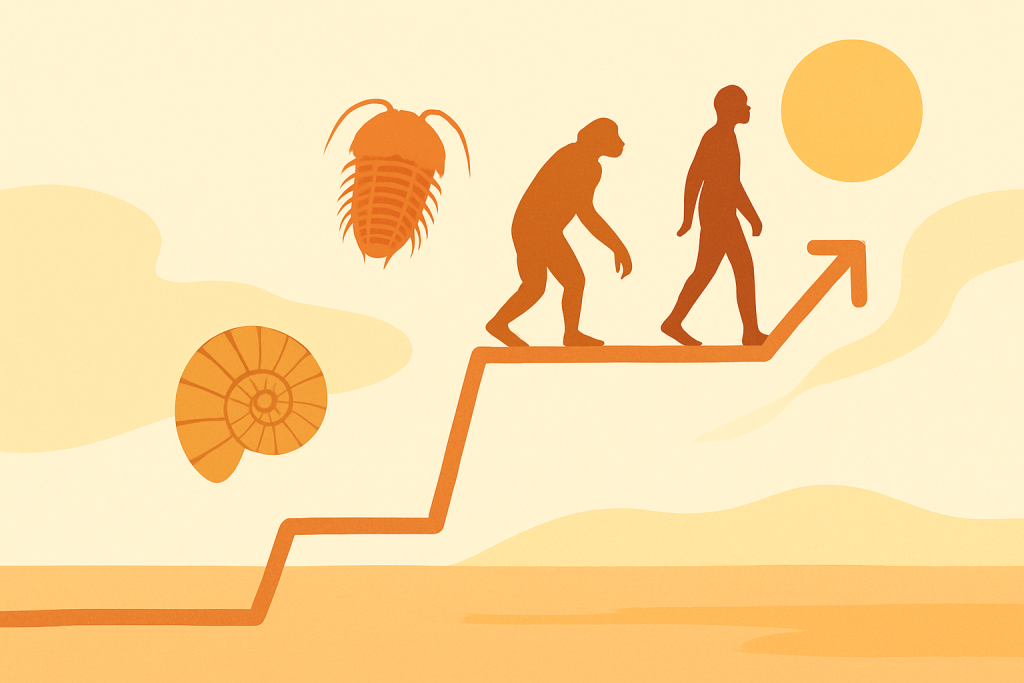
You know that feeling when nothing seems to change for ages—same routine, same habits, same you—and then suddenly a lot shifts at once? Perhaps a new friend group forms quickly, you switch majors, you move to a new city, or one tough week forces you to get serious about sleep and financial management. Gould and Eldredge argue that the history of life often follows this pattern: long periods where a species remains essentially unchanged, with only minor fluctuations, followed by brief periods during which a new species emerges and change is concentrated.
In their “punctuated equilibria” view, the main action isn’t a slow, steady makeover happening little by little inside one significant, stable population. Instead, the most noticeable change is tied to speciation—when one line splits and a new species forms—often in small, isolated groups, and on the fossil record clock, which can appear almost instantaneous. The practical takeaway is surprisingly personal: if you expect your life to improve in a perfectly smooth line, you’ll feel like you’re failing whenever progress comes in jumps. Tracking your habits or journaling can reveal weeks of stability, which are just as crucial as the leaps, helping you understand what’s steady, fragile, and triggers change.
They also warn that people can get fooled by their own expectations. Paleontologists, they argue, spent a long time hunting only for slow, steady change and treating gaps and standstills as mistakes or “nothing to see,” which made the “always gradual” story feel more common than it really was. This highlights a bias: if you only look for one type of evidence, you’ll confirm what you already believe. To make more intelligent decisions about fitness, studying, or relationships, try shifting your focus-notice the quiet periods, not just the dramatic moments. Recognizing that significant leaps often follow specific conditions, such as a new environment or constraint, can help you understand your own patterns more effectively.
Finally, Gould and Eldredge say that significant trends can emerge even if individual species don’t slowly transform step by step. A trend can emerge from which species thrive and spread, while others decline. So, the “direction” you see later is more like the result of winners piling up than a single, continuous self-improvement story. They even point to human evolution as an example where they report no detected gradual change within a given hominid group. At the same time, a long-term pattern, such as the development of larger brains, could result from the success of different, mostly stable groups over time. If you bring that down to daily life, it suggests a kinder way to read your own “trend.” You don’t have to force yourself to become a brand-new person through nonstop tiny upgrades. Sometimes the real change comes from choosing a new “branch”: a new circle, a new routine, a new project that fits better—and then letting the stable parts of you do their job until the next meaningful jump.
Reference:
Gould, S. J., & Eldredge, N. (1977). Punctuated equilibria: the tempo and mode of evolution reconsidered. Paleobiology, 3, 115–151. https://www.jstor.org/stable/2400177
Privacy Notice & Disclaimer:
This blog provides simplified educational science content, created with the assistance of both humans and AI. It may omit technical details, is provided “as is,” and does not collect personal data beyond basic anonymous analytics. For full details, please see our Privacy Notice and Disclaimer. Read About This Blog & Attribution Note for AI-Generated Content to know more about this blog project.