Climbing the Peaks of Progress: How Small Steps (and Occasional Jumps) Help Us Improve

Picture a group project that starts messy. Everyone tries tiny tweaks—renaming a file, switching slides, or fixing one chart. Each fix helps a bit, but soon you’re “stuck” on a version that’s decent, not amazing. To get something truly great, you might need a bigger change—like rebuilding the deck around a sharper story. That’s the basic idea behind how improvement often works in life: we take small steps up a hill, but sometimes we need a jump to reach a higher one. Kauffman and Levin use this simple picture to explain “adaptive walks,” their way of describing how things—organisms, ideas, even study plans—get better over time on a rugged landscape full of peaks and valleys. 

According to Kauffman and Levin, imagine every possible version of something as a point in a huge space, and give each point a “fitness” score—how well it works. Moving to a version that’s one small change away is like taking a step to a neighbor on this map. Many maps are bumpy, with lots of little peaks where nearby options are worse, so small-step climbing can end early at a “local optimum.” On totally random (uncorrelated) maps, there are tons of these local peaks, so most improvement paths are short—think a handful of steps before you top out. A greedy strategy that always picks the best neighboring step is even shorter. That’s why quick tweaks often help fast, then stall. 

Here’s the twist that matters for everyday life: progress slows as you get better because you have fewer “better neighbors” left. Early on, lots of options beat what you have, so branching out is easy; later, choices shrink and things feel stuck—Kauffman and Levin call this pattern “radiation then stasis.” One fix is to allow bigger leaps—try several changes at once. When the jump is big enough, you can escape the local peak and discover fresh ground. In that “long-jump” mode, they find a simple rule of thumb: the number of improvements grows roughly with the log of the time you keep searching. Translation: early wins come quickly, then the gaps between wins get longer, which feels slow but is normal. 

What can you do with this? When your workout, study routine, or side hustle stops improving with tiny tweaks, treat that as a signal. First, accept that short bursts of progress are followed by plateaus, which are built into the rugged nature of maps. Next, plan occasional, safer “jumps”: test a new schedule for a week, learn a different tool, or reorganize roles on your team. Expect that the better you already are, the rarer the easy wins—and that’s okay. Take small steps for steady gains, and reserve bold experiments for breaking out of ruts. That mix—patient climbing plus brilliant jumping—is how you keep finding higher peaks in school, work, and everything in between.

Reference:
Kauffman, S., & Levin, S. (1987). Towards a general theory of adaptive walks on rugged landscapes. Journal of Theoretical Biology128(1), 11–45. https://doi.org/10.1016/S0022-5193(87)80029-2

Leveling Up Your Choices: How Simple Rules Help You Learn Faster

You’re juggling classes, a part-time job, and maybe a side hustle. Every week brings a new app to try, a study trick to test, and a different way your friends are making money online. It can feel like the world keeps changing just when you think you’ve figured it out. Holland and Miller describe this kind of world as one that’s always throwing something new at us, where smart choices come from adapting step by step rather than guessing the perfect plan in advance. In their view, useful patterns can be tested inside “artificial worlds,” like simulations, so we can watch how strategies improve over time and see which ones actually work. 

According to Holland and Miller, many real-life settings look like “complex adaptive systems.” Think of a campus or a marketplace: lots of people trying things, learning from feedback, and adjusting based on what everyone else does. There isn’t one final, perfect strategy; instead, you find local “niches” where certain habits pay off—like a study routine that works for your schedule or a pricing trick that fits your small shop. New moves by others create new niches, so improvement never really stops—more like constantly upgrading your loadout in a game than finishing a final boss. 

So how do you get better inside a shifting system? One idea is to learn the way a basic “genetic algorithm” learns: keep a bunch of simple strategies, reward the ones that perform well, and mix their best parts to create new ones. In plain terms, if Pomodoro sprints help you focus and walking meetings spark ideas, combine them into “walk, then sprint” and test again. This mixing step—called “crossover”—is powerful because it builds on what already works, instead of starting from scratch each time. Over many rounds, you bias your search toward better “building blocks,” and your average results rise without you needing perfect information or heavy math. 

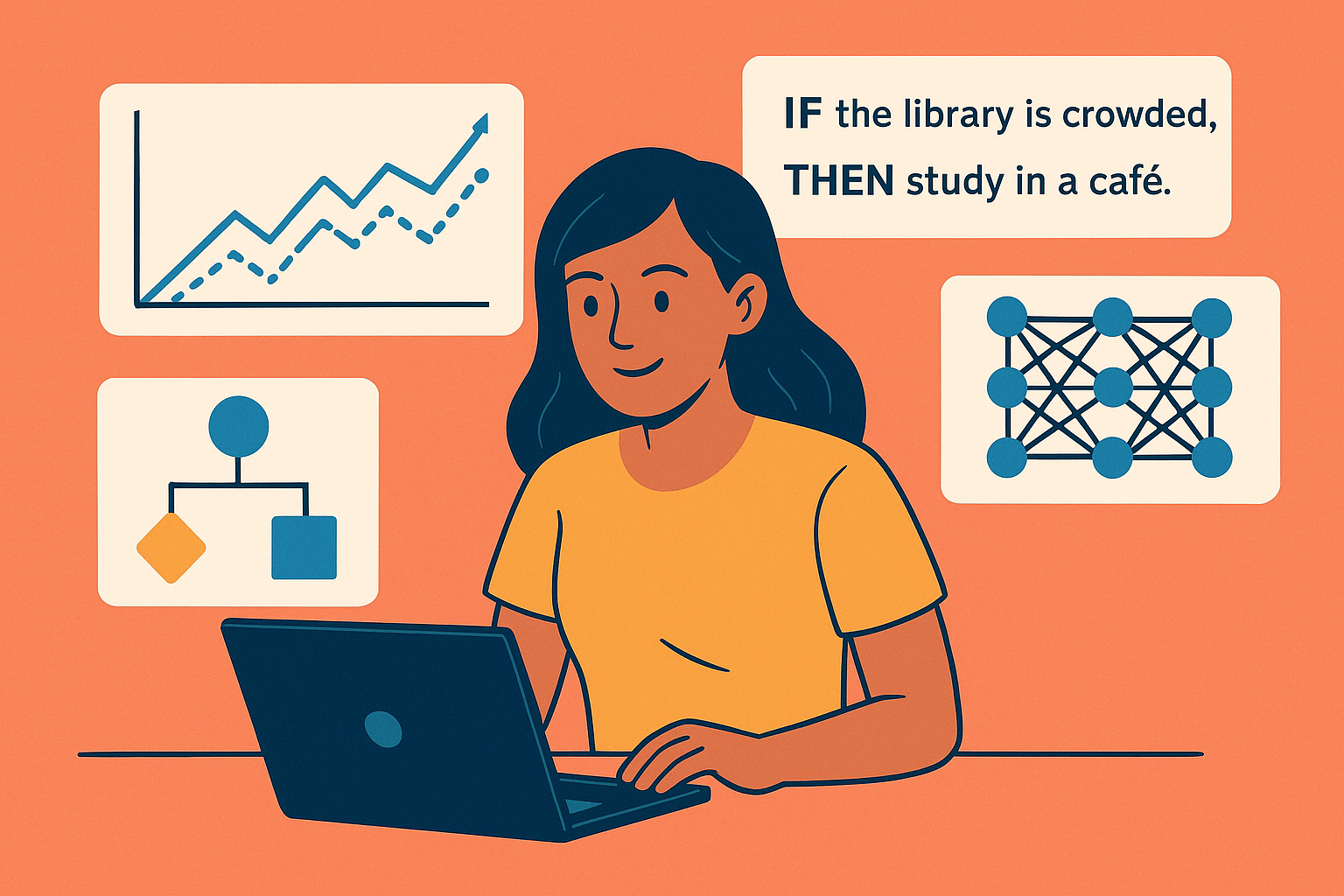
Another tool they discuss is a “classifier system,” which you can picture as a bunch of if-then rules competing to guide your next move: if the library is crowded, then study in a quiet café; if a post flops, then try a shorter caption. Each rule earns “strength” when it helps you get a payoff and loses strength when it doesn’t—like a built-in scoreboard for your habits. Over time, helpful rules link up, forming smarter routines that still stay flexible, because every rule is provisional and can be replaced when the world changes. This way of learning—small rules, constant feedback, and recombining what works—makes progress feel doable even when wins are rare or delayed. It’s a reminder that you don’t need to be all-knowing to act more intelligently tomorrow than you did today.

Reference:
Holland, J. H., & Miller, J. H. (1991). Artificial Adaptive Agents in Economic Theory. The American Economic Review, Papers and Proceedings of the Hundred and Third Annual Meeting of the American Economic Association81(2), 365–370. https://www.jstor.org/stable/2006886

How Tiny Mistakes Can Grow Cooperation

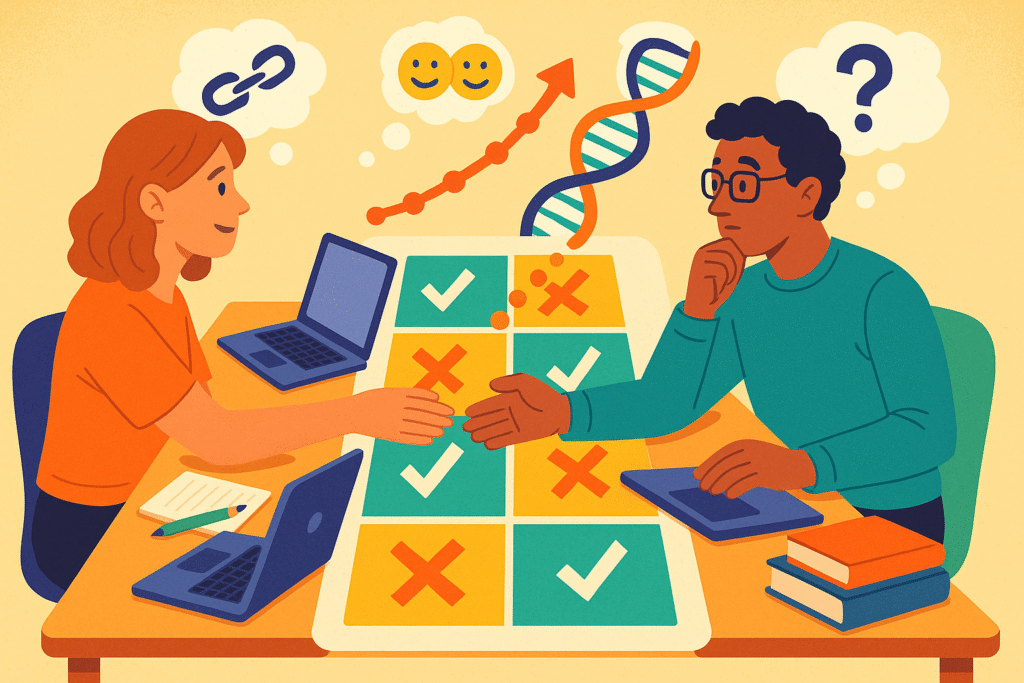
You and a friend decide to study together every week. Most days, you both show up and share notes. Now and then, someone is late, or a message gets lost, and the plan derails. Do you quit, forgive, or try a new routine? Kristian Lindgren built a simple computer world to study choices like these. In his world, many “students” play a repeated cooperation game, sometimes make mistakes, and learn over generations which habits survive. The surprise is that small errors don’t just cause chaos. They can encourage communities to adopt smarter, fairer ways of cooperation. 

Here’s the setup in everyday terms. Each player follows a short rulebook, like “if they helped me last time, I help now.” These rulebooks are like tiny genomes with memory, and they can change through “mutations” such as flips, copies, or trims—simple edits that create new habits to test. Everyone plays everyone, good habits earn more “offspring,” and the game keeps going. Even a classic friendly rule like “Tit for Tat” struggles when messages glitch, averaging less than perfect because error cascades can lock partners into pointless payback. Lindgren illustrates how this occurs and how new, stricter rules emerge when mistakes are prevalent. 

What grows out of this messy mix is very relatable. Populations sit in long, calm periods, then flip fast into something new—like a group project that works for weeks and suddenly collapses when one shortcut spreads. Sometimes two different “okay-but-flawed” rules prop each other up: when they meet, they sync and recover cooperation after a slip, even though each one alone would spiral into conflict. Later, sturdier rules emerge that recall a bit more history and respond to one defection with two firm responses before returning to peace. That move blocks freeloaders and keeps the average payoff high even with noise, much like setting clear boundaries after someone flakes. 

So what can you use today? First, expect errors and design for recovery. If a friend misses once, don’t nuke the friendship; try a brief, clear consequence and then reset. Second, remember that patience plus memory beats snap reactions. Keeping track of the last couple of interactions helps you respond fairly, not just emotionally. Third, watch for sneaky patterns that benefit in the short term but ultimately erode trust; they can cause “extinctions” where good vibes vanish for everyone. Lindgren’s message is simple: cooperation is not naïve. With the right habits, it’s robust, even when life is noisy.

Reference:
Lindgren, K. (1991). Evolutionary Phenomena in Simple Dynamics. In C. G. Langton, C. Taylor, J. D. Farmer, & S. Rasmussen (Eds.), Artificial Life II, SFI Studies in the Sciences of Complexity. Santa Fe Institute. https://www.researchgate.net/publication/258883366_Evolutionary_Phenomena_in_Simple_Dynamics

Why So Much of Life Runs Through Organizations (and How That Helps You)

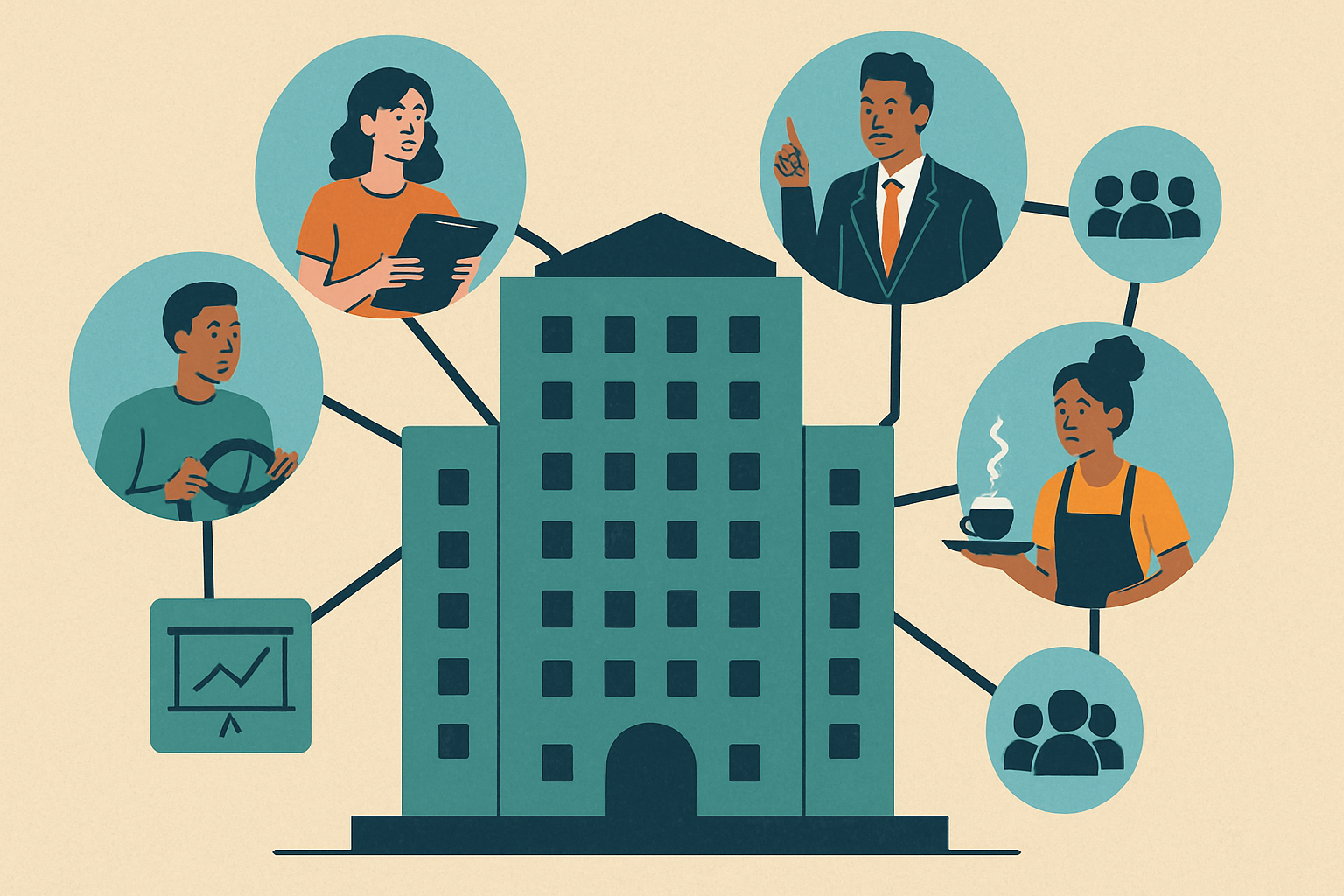
Picture your day. Classes, a part-time job, a club meeting, maybe a shift at the cafe. Notice a pattern? Almost everything happens inside a group with rules, roles, and someone setting direction. Herbert A. Simon suggests that if a visitor from Mars looked at Earth, they’d see big “green” zones of organizations connected by thin “red” market lines—and they’d probably call this an “organizational economy,” not just a market one. The label matters because it changes what we pay attention to in real life: most people are employees, not owners, and the big question becomes how groups actually get people to work toward shared goals. 

Simon argues that classic theories love markets and contracts, but the real action is inside firms—schools, startups, nonprofits, public agencies—where people coordinate every hour. One reason firms exist is the employment deal: you agree to take direction now for tasks that can’t be fully predicted or negotiated in advance. That’s an “incomplete” contract, and it’s efficient when the future is messy. Day to day, you’re not micromanaged; you work within a “zone of acceptance” where lots of choices are fine to you but important to your boss—like which customer email to answer first or which drink to prep next—so orders can focus on results, principles, or constraints instead of step-by-step instructions. That’s why initiative matters: good work isn’t just “follow every rule,” it’s spotting decisions and moving things forward. 

So why do people try hard if a contract can’t spell everything out or pay for every extra effort? Money and promotions help, but they’re not enough on their own. Simon points to identification—the feeling of “we”—as a powerful everyday engine. When we’re taught and encouraged to care about the team, we take real pride in its wins and act for the group, not just ourselves. He links this to a broader human trait he calls “docility,” meaning teachability and responsiveness to social norms, which makes loyalty and cooperation common—even when they’re not instantly “selfish.” For you, that’s practical: choose teams where the “we” is clear, learn the local goals fast, and use simple scoreboards (quality, safety, service) to guide choices when no one is watching. That mix—some rewards, strong identity, and clear cues—explains why many organizations work surprisingly well. 

There’s one more everyday superpower of organizations: coordination. Think of “rules of the road,” or the registrar that turns campus chaos into a class schedule—standards that let everyone predict each other and get on with it. Beyond rules, groups also balance things by quantities, not just prices: low bin of cups? The system reorders; suppliers schedule production; the whole chain adjusts. Put together—authority used to set clear goals, a shared “we” that motivates effort, and simple coordination tools—organizations can specialize deeply and still run smoothly. That’s why Simon says modern economies are best seen as organizational economies, and why learning to navigate teams is a life skill as useful as any class.

Referencia:
Simon, H. A. (1991). Organizations and Markets. Journal of Economic Perspectives5(2), 25–44. https://doi.org/10.1257/jep.5.2.25

How Markets Quietly Shape What We Want

We often think our tastes and values are purely personal, but Bowles argues that everyday systems—like shops, apps, schools, and jobs—nudge them all the time. Markets don’t just set prices; they set the scene. Paying taxes for a service feels different from buying the same thing yourself. One frames you as a citizen with rights; the other as a customer engaging in a transaction. That frame alters how fair something appears and how generous we perceive it to be. In lab games, people offered less when the situation was described like a market “exchange” and more when it felt like “splitting a pie.” Even money itself can be a powerful simplifier. In older communities studied by Bohannan, certain items weren’t traded across categories. As money spread, more items became comparable, and that changed what felt OK to swap—and what a “good life” looked like.

Motivation shifts, too. When we do things for a reward, we often start liking the activity less. Psychologists such as Deci and Ryan have demonstrated that paying or punishing can crowd out pride, curiosity, and the sense of choice. Bowles reviews real-world hints of this: when people were offered cash to accept an unpopular facility in their town, support fell; paying for blood donation sometimes made willing donors less likely to give. The takeaway isn’t “money bad.” It’s subtler: clear quid-pro-quo deals push us to focus on the payoff, while choice and autonomy keep our inner drive alive. In your daily life, that might mean mixing paid gigs with passion projects, or keeping some hobbies reward-free so they stay fun.

Norms and reputations also depend on the setting. In tight communities or teams where you’ll meet again, being trustworthy pays off. In fast, anonymous markets, identity matters less, so it’s harder for reputations to grow—and easier to act only for yourself. But market life isn’t destiny. Simple tweaks—such as talking face-to-face, showing names, or building group identity—can increase cooperation. Consider how you buy and sell online: profiles, reviews, and repeat interactions make kindness and reliability more prevalent, as your behavior now follows you later.

Finally, we learn what to value from the people around us. Bowles demonstrates that culture spreads vertically (from parents), obliquely (through teachers and creators), and horizontally (among friends). Conformity isn’t always mindless; it can be a smart shortcut when learning is costly. That’s why “what everyone does” is so sticky. Markets can shift who we see, what gets praised, and which paths look successful—so the role models change, and so do we. For everyday life, the message is empowering: choose your frames and your crowds. Decide which activities you’ll keep intrinsic. Build circles where your future self will meet you again. Small design choices—how you pay, how you participate, who you follow—quietly train your preferences. Use them on purpose.

Reference:
Bowles, S. (1998). Endogenous Preferences: The Cultural Consequences of Markets and Other Economic Institutions. Journal of Economic Literature36(1), 75–111. http://www.jstor.org/stable/2564952