How Your Brain Runs Its Own Belief Network

Imagine you are at university, sitting in the library, when three things happen almost simultaneously. A friend messages you, “Huge storm coming, buses might stop.” At the same time, you see a dark cloud through the window, and then you read a post online saying, “Public transport strike today!” In a few seconds, you decide whether to pack up and leave or keep studying. You do not write down equations, but you quickly combine these bits of information, ignoring some while trusting others more, and end up with a single decision. This everyday moment is precisely the kind of situation that Pearl describes when he talks about “belief networks” and how we fuse and spread information in our minds.

Pearl describes a belief network as a web of small questions about the world, each one represented as a node, with arrows indicating which ideas directly influence which. A node might be “there is a storm,” another “the bus is late,” another “I see dark clouds,” and so on. Instead of trying to track every possible combination of all these ideas, the network only stores simple, local relationships: how strongly one thing affects another. Pearl explains this using examples like suspects, fingerprints, and lab reports, where each piece of evidence is linked to a possible cause. The key insight is that our mind does not handle one giant, impossible table of chances; it uses many small links between related ideas, which is much closer to how we actually think when we ask, “If this is true, how likely is that?”

Once the network is in place, new information has to move through it, and this is where things become very practical. Pearl shows that each link can carry two kinds of support: one coming from “causes” (what usually leads to this) and one from “effects” (what we have seen that points back to it). When something changes—say you get a new lab report, or in your life, a new message, a news alert, or a friend’s opinion—that update first affects the nearby node and then spreads step by step through the network. Importantly, each node only communicates with its neighbors, so the process is local and easy to manage, yet the final picture remains globally consistent. Pearl even warns that we must avoid counting the same clue twice, like when a rumor appears on several accounts that all secretly copy each other. His method keeps “upward” and “downward” flows of belief apart so they do not get stuck in loops of self-reinforcement.

Another idea from Pearl that fits daily life is the concept of multiple explanations competing. In one story, an alarm can be triggered by either a burglary or an earthquake. Hearing that the alarm went off increases your belief in both causes. Still, once you also hear a reliable earthquake report, the “earthquake” explanation makes the “burglary” explanation less likely, because one clear cause can “explain away” the same event. The same pattern appears when you feel tired before an exam: you might blame stress, lack of sleep, or getting sick. A positive COVID test, for instance, suddenly shifts most of your belief toward one cause and away from the others. Pearl and colleagues also discuss “hidden causes,” extra nodes that we do not directly see but that help explain why several things tend to happen together, such as a shared background reason for your friends’ moods or repeated delays on your train line. Thinking in terms of these networks can help young people make better choices: check where your information really comes from, notice when two pieces of “news” are actually the same source, and remember that one good explanation can reduce the need to invent many others. In short, your mind is already running a belief network; learning to see it that way can make your everyday reasoning clearer, calmer, and more honest.

Reference:
Pearl, J. (1986). Fusion, propagation, and structuring in belief networks. Artificial Intelligence29(3), 241–288. https://doi.org/10.1016/0004-3702(86)90072-X

Why Crowds Move Like Magic (and How You Can Use It)

Picture this: you and your friends are leaving a concert, and thousands of people flood the streets. Nobody is shouting directions, yet the crowd curves around barriers, speeds up in open space, and slows near the subway stairs. It feels almost choreographed, but each person is just watching what’s right around them and adjusting a little at a time. That everyday scene is the same idea Craig Reynolds describes for birds in the sky and fish in the sea: complex group motion can emerge from simple rules followed locally, not from a central authority.

According to Reynolds, flocking occurs when individuals balance three urges: avoiding collisions with neighbors, matching their speed and direction, and staying close to the group. In practice, that means you step sideways to avoid bumping someone (separation), you fall into the same walking pace (alignment), and you drift back toward your friends if you’re sliding to the edge (cohesion). Each member only “pays attention” to nearby neighbors and what’s ahead—no one needs a full map of the whole crowd. Add gentle steering around obstacles and a shared pull toward a goal—such as an exit sign or your meeting spot—and the whole group flows smoothly.

Why does this matter to you? Because the same rules help in daily life. When biking through traffic or skateboarding in a busy park, think like a flock: maintain a safe distance, synchronize your speed with the lane, and aim for clear space rather than forcing your way through. In team games, you can move as a unit by mirroring a teammate’s direction and spacing instead of waiting for shouted commands. Even your study group works better with these habits: avoid “collisions” by not talking over others, align by matching the group’s focus, and keep close enough that no one drifts out of the conversation. Small, quick adjustments beat big, late corrections.

There’s also a creative twist. Animators and game designers utilize these simple rules to create realistic crowds, schools of fish, or traffic without scripting every path. You can apply the same mindset to planning events or routes: assume people follow what they see around them, not a master plan. Place obstacles so they gently nudge the flow instead of blocking it. Start a “turn” from one side and let it ripple like a chorus line. And remember the secret of smooth motion: prioritize. In a tight spot, safety comes first (avoid collisions), then match pace, and then regroup. When you practice these three habits, you’ll find that everyday movement—leaving a concert, changing buses, or walking to class—starts to feel less like chaos and more like quiet, shared choreography.

Reference:
Reynolds, C. W. (1987). Flocks, herds and schools: A distributed behavioral model. ACM SIGGRAPH Computer Graphics21(4), 25–34. https://doi.org/10.1145/37402.37406

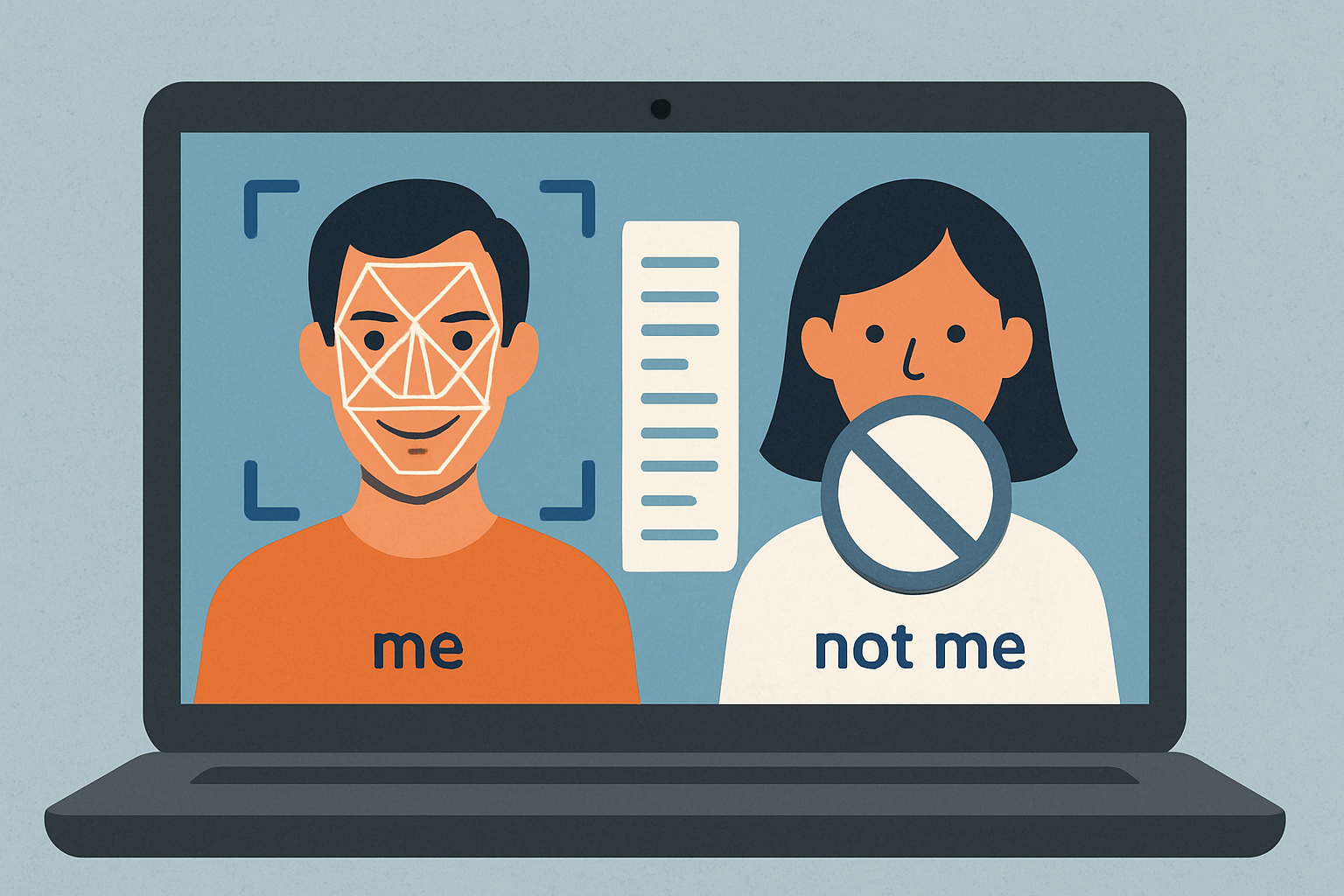
How Your Computer Can Tell “Me” from “Not Me”

You open your laptop, and a familiar app feels off. It launches slower. A button is gone. Is it just a glitch, or did something actually change? Forrest and colleagues suggest a simple way to think about this: teach the computer what “self” looks like, then watch for anything that isn’t “self.” Their idea borrows from the immune system, turning change detection into a game of “spot the difference.” Instead of chasing every known virus pattern, the system learns your files when they’re clean and flags anything that doesn’t match that clean picture.

Here’s how it works, in everyday terms. Take a file you want to protect and slice it into many small pieces, like cutting a playlist into short clips. Then generate lots of random “detectors,” but immediately throw away any detector that looks too much like your file pieces. That pruning step is called “censoring.” What’s left is a customized set of detectors that match almost anything except your file. Later, the computer regularly compares your file pieces to those detectors; if one suddenly matches, something changed, and you get an alert. The matching rule is flexible: it doesn’t need a perfect match, only a few symbols in a row, which makes it sensitive to real edits. This approach is best suited for items that shouldn’t change often, and it won’t detect pure deletions, which is a known limitation.

The clever twist is probability. Each computer (or app) builds a unique detector set, so even if an attacker slips past one, the same trick is likely to fail elsewhere. System-wide reliability ends up high, even if any single spot is only “pretty good.” You can tune how cautious the system is: more detectors cost more to prepare but provide stronger protection, while day-to-day checking remains inexpensive. Experiments in the paper demonstrate the idea’s ability to catch everything from minor edits to simple file-infecting viruses, and detection improves rapidly when multiple independent copies are involved. Protection is also symmetric: if someone tries to tamper with the detectors themselves, the same checking process detects that change as well.

What does this mean for your daily life? Think of it as a mindset: know your “self,” then watch for drift. When you install software or store important notes, taking a clean snapshot and checking against it later can reveal sneaky changes early. You can also spread the checking across multiple locations—such as a laptop, cloud copy, or external drive—to achieve that system-level boost from diversity. The authors are honest about trade-offs: generating a strong detector set can be computationally intensive, and attackers could try tricks like reusing their own pieces, so varying how you slice things raises the bar. The bottom line is motivating: by learning “me” first and automating the “is this still me?” question, you gain a practical, immune-inspired way to keep your digital content trustworthy without getting bogged down in technical jargon.

Reference:
Forrest, S., Perelson, A. S., Allen, L., & Cherukuri, R. (1994). Self-nonself discrimination in a computer. Proceedings of 1994 IEEE Computer Society Symposium on Research in Security and Privacy, 202–212. https://doi.org/10.1109/RISP.1994.296580

Why There’s No “Best” Strategy (and How to Pick One That Fits You)

We all love shortcuts. The perfect study hack. The ultimate workout plan. The “best” way to search for answers online. Wolpert and Macready show that this dream has a catch: there’s no single method that wins across every kind of problem. When you average over all possible situations, every strategy performs the same. If one approach excels in some tasks, it must falter in others. Even a random strategy can look just as good—on average—if you judge it across every problem out there.

So what actually works? Match the method to the kind of problem you face. The authors explain this as “alignment.” Think of it like playlists. A gym playlist pumps you up, but it’s awful for falling asleep. In the same way, an algorithm—or any plan—needs to fit the pattern of the task. If you know something about your problems (for example, your homework tends to be practice-with-small-twists, not total curveballs), build your approach around that. Without using what you know, you’re basically picking at random and hoping for luck.

Life also changes while you’re working. Projects shift, goals change, and new information arrives midway. The same “no free lunch” idea still bites in these time-varying situations: after the very first step, no fixed approach dominates across all possible ways things can change. What helps is paying attention to how your world usually shifts. If your schedule becomes busy near exams, use strategies that adapt—such as quick checkpoints and backups—rather than rigid plans that assume nothing will change.

One more practical warning: don’t overhype wins from tiny tests. The authors demonstrate that outperforming another method on a small set of examples doesn’t prove much; it only indicates that you were better in those specific cases. Instead, track results over the kinds of tasks you actually face, and compare to simple baselines. If your fancy routine isn’t clearly better than a plain, honest approach, rethink it. In short, there’s no universal champion. But by learning the shape of your own problems and choosing tactics that match that shape, you turn “no free lunch” into a recipe that works for your everyday life.

Reference:
Wolpert, D. H., & Macready, W. G. (1997). No Free Lunch Theorems for Optimization. In IEEE Transactions on Evolutionary Computation (Vol. 1, Issue 1). doi: 10.1109/4235.585893

Learn Faster with the “Natural” Gradient

When you’re learning something new, you don’t just step randomly—you look for the path that gets you downhill fastest. Amari explains that many machine-learning models live on curved spaces, so the usual gradient doesn’t actually point straight “down.” The fix is the natural gradient, which adjusts each step to the true shape of the space so updates follow the steepest descent where it really matters. In simple terms, the algorithm stops slipping sideways and starts moving directly toward better settings. This idea originates from information geometry and applies to perceptrons, mixing-matrix problems such as blind source separation, and even linear dynamical systems used for deconvolution, not just toy examples.

Why care? Because using the natural gradient in online learning (updating as each new example arrives) can be as accurate, in the long run, as training with all data at once. Statistically, Amari shows this reaches “Fisher efficiency,” which means the online method eventually matches the gold-standard batch estimator instead of settling for second best. For everyday intuition, think of studying a little every day and still getting the same score as if you’d crammed with the full textbook—provided you study in the smartest direction.

This smarter direction can also dodge the annoying “plateaus” that slow standard backprop training, where progress feels stuck even though you’re doing everything “right.” By respecting the curvature of the model’s parameter space, natural-gradient steps help the learner escape these flat regions more readily, speeding up practical training of neural networks. Amari highlights this benefit while positioning the method across common tasks, from multilayer perceptrons to separating mixed signals, such as voices in a room or unmixing time-smeared audio.

There’s also a tip for tuning your learning rate without guesswork. The paper proposes an adaptive rule that makes big steps when you’re far from the goal and smaller steps as you get close, helping you converge quickly without overshooting. It’s like running on open ground but slowing near the finish line to avoid slipping past it. This adaptive schedule aligns naturally with the natural gradient, offering a practical approach that can be applied in real-world training loops.

Reference:
Amari, S. (1998). Natural Gradient Works Efficiently in Learning. Neural Computation, 10(2), 251–276. https://doi.org/10.1162/089976698300017746