When Your Model Isn’t Big Enough: How We Learn to See Hidden Patterns

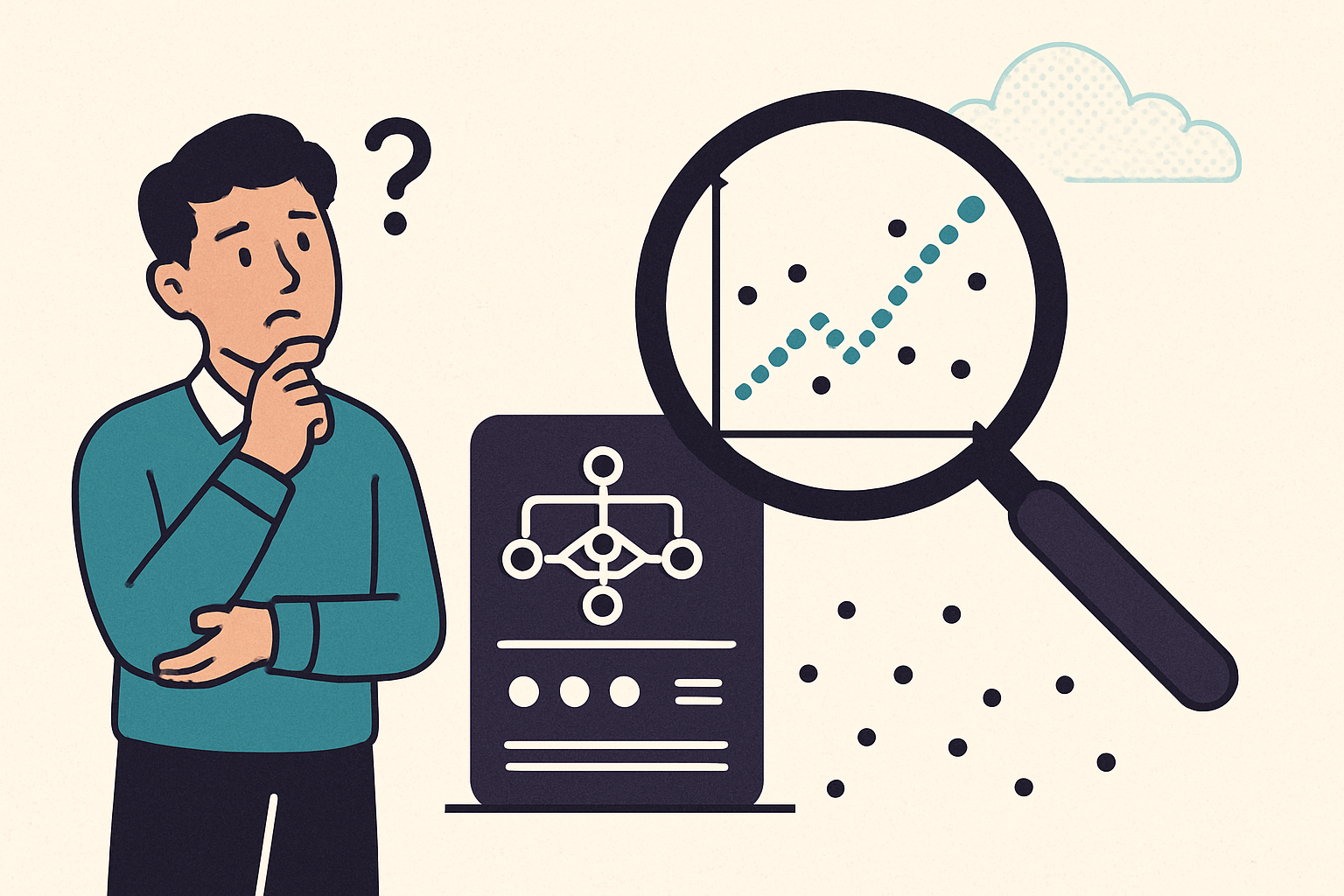
Picture you trying to make sense of a messy playlist. At first, you just note each song. Soon, you group them by mood. Then you realize there’s a deeper rule: the same three vibes always cycle, just in different lengths. You didn’t change the music. You changed how you looked at it. James P. Crutchfield describes this shift as “innovation” in how we model the world. When our current way of organizing data runs out of steam, we jump to a new, more capable way of seeing cause and effect. That jump, not more data alone, is what reveals the structure that felt like noise a moment ago.

Crutchfield’s method, called hierarchical ε-machine reconstruction, climbs a ladder of models, starting with the raw stream, then moving to trees, and finally to finite automata, and, if necessary, to richer machines. Try the simplest class first; if the model continues to grow as you feed it more data, that’s your cue to “innovate” and move up a level. The goal is the smallest model at the least powerful level that still captures the regularities, because small, right-sized models predict best. Think of it like upgrading from sorting songs one by one to folders, to smart playlists that automatically recognize patterns. The process continues until your model remains finite and predictive.

When should you upgrade? Crutchfield offers a simple rule of thumb: innovate once your model’s size reaches the point where it pushes against your own capacity. He even defines an “innovation rate” to identify when complexity is escalating as you refine the fit. If you ignore that signal, you’ll mistake lawful structure for random chatter. Real examples make this vivid. At the edge of chaos in a classic system, a naive model explodes into infinitely many states; the fix is to innovate a new representation that uses a stack-like memory, turning the “infinite” into a tidy finite description. And sometimes the opposite lesson hits: use the wrong instrument, and even a simple world looks impossibly complex. The remedy is to innovate the sensor model itself—say, by adding a counter that tracks how long you’ve seen the same symbol—so your description shrinks back to size.

Why does this matter day to day? Because we all model. Studying, budgeting, training, even scrolling—each is a guess about “what comes next.” Crutchfield shows that progress comes from knowing when to keep it simple and when to change the game. If your study notes become bloated without boosting recall, consider switching from lists to concept maps. If your workout tracker can’t spot plateaus, add a new feature like moving averages—a small “counter” that changes what you can see. If a chaotic group chat looks unreadable, filter for themes—your “domain and particle” view—to reveal structure under the noise. The big idea is practical: organize your limited attention into smarter models and be ready to innovate when your current one reaches its limits. That’s how hidden order shows up, prediction improves, and “random” turns into patterns you can actually use.

Reference:
Crutchfield, J. P. (1994). The calculi of emergence: computation, dynamics and induction. Physica D: Nonlinear Phenomena75(1–3), 11–54. https://doi.org/10.1016/0167-2789(94)90273-9

Seeing Hidden Order in a Noisy World

You’re scrolling through your phone, jumping from texts to videos to homework. Some things feel random. Some things feel predictable. Yet you still try to guess what comes next — the plot twist, the next notification, the teacher’s quiz question. Crutchfield argues that this everyday guessing game mirrors how scientists build models: they try to capture the useful patterns and treat the rest as “noise,” balancing simple explanations with good predictions instead of chasing either alone. In practice, the “best” model is the one that minimizes both the model’s size and the leftover randomness.

According to Crutchfield, what makes something truly interesting isn’t just pure order or pure randomness, but the mix in between. He describes “statistical complexity,” a method for measuring the amount of structure a process possesses. Purely random and perfectly periodic signals are actually simple by this measure; the richest structure lives between those extremes, where predictable and unpredictable pieces interact. Imagine a playlist that’s not totally shuffled and not a loop — it feels “designed” because it has memory and variation. That’s where complexity peaks.

Here’s the twist that helps in real life: systems can create patterns that the system itself then uses. Crutchfield calls this “intrinsic emergence.” Think of prices in a marketplace or trending topics online. They don’t come from one boss; they emerge from everyone’s actions and then guide what everyone does next. In this view, something “emerges” when the way information is processed changes — when the system gains new internal capability, not just a new look from the outside. That’s different from simply spotting a pretty pattern after the fact.

So, how do we improve at spotting and utilizing structure? Crutchfield’s answer is to build the simplest model that still predicts well, then upgrade only when the current approach continues to grow without limit. His framework, based on reconstructing minimal “machines,” treats model size as the memory you need to make good forecasts; when your model bloats, you “innovate” to a new class that captures the pattern more cleanly. In everyday terms: don’t memorize every detail of a course, a habit, or a feed; learn the few states that actually matter for predicting what comes next — and when that stops working, change how you’re thinking, not just how much you’re cramming.

Reference:
Crutchfield, J. P. (1994). The calculi of emergence: computation, dynamics and induction. Physica D: Nonlinear Phenomena, 75(1–3), 11–54. https://doi.org/10.1016/0167-2789(94)90273-9

Test-Drive Your City: How Simple Simulations Make Smarter Policies

Cities are messy. Many people, rules, and surprises collide, which means even good intentions can backfire. Sandoval Félix and Castañón-Puga argue that decision-makers should “mock up” policies on a computer first, like trying a route in a map app before leaving home. These lightweight models allow people to explore what might happen if they build a new park, change bus routes, or tighten zoning—before affecting the real city. That kind of “anticipatory knowledge” helps avoid short-term fixes that create long-term problems.

The chapter explains why this matters: cities aren’t machines that can be tuned with one knob. They’re complex systems where small tweaks can trigger big, unexpected outcomes, because everything is connected. In complex systems, patterns “emerge” from many small actions—think of traffic waves or shopping streets that pop up on their own. This is why looking only at one piece often fails. The complexity lens focuses on interactions and probabilities, rather than rigid plans, allowing policies to account for side effects across different parts of the city.

To explore these interactions, the authors highlight agent-based models—small worlds filled with “agents” (such as households, shops, or buses) that follow simple rules. There’s no central boss; each agent has limited knowledge and reacts to its surroundings. When you run the simulation, their choices add up to city-scale patterns. A related technique, cellular automata, applies these rules to a grid, allowing nearby cells to influence each other—useful because, in cities, what’s next door often matters most. These tools don’t predict the future with certainty, but they help identify counterintuitive moves, path-dependent traps, and situations where individual wins don’t add up to a public win.

Getting started is less scary if you treat it like learning a creative skill. The authors suggest tinkering first, building simple blocks, keeping version notes, and borrowing small code “snippets” from similar models. Even sketching a flow diagram helps you stay focused and avoid accidental behaviors. Then, present the results clearly: use plain language, visuals, and connect the outputs to real-life steps, such as which rules or budgets would need to be changed. Communication guides, such as ODD/ODD+ D and the STRESS checklist, can help keep your work organized and understandable for non-experts. The point isn’t perfection—it’s making choices that are better informed, more transparent, and less likely to surprise everyone later.

In everyday terms, this chapter is an invitation to play “what if?” with the city you care about. Treat models like a safe sandbox where you can test ideas fast and see the ripple effects, not a crystal ball. When you understand that cities are living networks, you’re more likely to ask better questions, spot side effects early, and push for policies that work in the real world—not just on paper.

Reference:
Félix, J. S., & Castañón-Puga, M. (2019). From simulation to implementation: Practical advice for policy makers who want to use computer modeling as an analysis and communication tool. In Studies in Systems, Decision and Control (Vol. 209). https://doi.org/10.1007/978-3-030-17985-4_6

Turning a Messy To-Do List into a Project You Can Actually Finish

Agile is a simple idea: build in short steps, listen to users, and be ready to change course fast. It’s used far beyond apps now, from classrooms to hospitals, because life rarely goes exactly as planned. Castañón-Puga and colleagues explain that many teams visualize work on a task board with three columns—To-Do, In Progress, Done—so everyone can see where things stand at a glance. Their study demonstrates how this setup aligns well with “earned value management” (EVM), a method for comparing what was planned with what was actually accomplished and spent. In plain terms, EVM answers: are we on time, on budget, and getting the value we expected?

Here’s the cheat sheet. Planned Value (PV) is what you expected to finish by now. Earned Value (EV) is what you truly finished. Actual Cost (AC) is the actual cost. Two quick ratios tell the story: SPI = EV ÷ PV (schedule health) and CPI = EV ÷ AC (cost health). If SPI or CPI is below 1, you’re slipping; above 1, you’re ahead. Think of a group project: if you planned to write four pages this week (PV), wrote only two (EV), and spent more hours than expected (AC), your SPI and CPI will warn you early, before the deadline panic hits.

The authors developed a simple simulator that resembles a Kanban board. Tasks move from To-Do to Done while team “agents” pick them up, work on them, and sometimes finish early or experience delays. A small dashboard displays a burndown chart of remaining tasks, a PV-EV-AC chart, and a live CPI/SPI plot, allowing you to see the project’s pulse in real-time. You don’t need fancy math to use the idea: keep a board, log the time you expected versus the time you actually spent, and watch the two indices. It’s like tracking study goals: set your plan, record actual hours, and spot slips before exam week.

What makes this practical is how small chances of “good luck” or “bad luck” add up. In 2,100 simulated runs, the team tested different conditions—namely, the number of people, the number of tasks each person juggles, and the odds of finishing early or late. A clear pattern emerges: higher chances of being delayed push CPI down, while higher chances of finishing early push CPI up. The number of people or tasks per person matters less than those delay/advance probabilities. So in everyday terms, reducing blockers and distractions (delay) and creating tiny speed-ups (advance) beats simply “throwing more people” at the work. Try time-boxing, clearer handoffs, or removing one recurring bottleneck; your CPI/SPI will thank you.

Why care? Because plans meet reality every day. Projects mix predictable steps and surprise twists, so you need flexibility and a quick feedback loop. A simple board, combined with an EVM, gives you both: you see the work, you measure progress, and you adjust quickly. Start small this week—list tasks, estimate hours, log actuals, and compute SPI and CPI. If they dip below 1, don’t stress; focus on fixing the causes you can control: fewer multitasking switches, fewer interruptions, and faster reviews. That’s how you turn a messy to-do list into a finish line you can actually reach.

Reference:
Castañón-Puga, M., Rosales-Cisneros, R. F., Acosta-Prado, J. C., Tirado-Ramos, A., Khatchikian, C., & Aburto-Camacllanqui, E. (2023). Earned Value Management Agent-Based Simulation Model. Systems, 11(2), 86. https://doi.org/10.3390/systems11020086

City Building 101: Why “Where Stuff Goes” Shapes Your Day

Sandoval-Félix et al. examine a simple question with significant everyday effects: where should a city allocate homes, jobs, and roads to ensure smooth operation? They model Ensenada, Mexico, and introduce a handy idea called “Attractive Land Footprints.” Think of these as spots that are extra tempting for new factories because they’re near workers and big roads, on gentle slopes, and away from homes. These spots don’t stay put—they pop up, move, shrink, or disappear as the city changes. That constant shape-shifting is why planning rules need to keep up.

Here’s the twist: the model finds that more of these “attractive” factory zones fall in places the current rules don’t allow than in places they do. In plain terms, demand for good industrial space exceeds what the plan permits. That mismatch pushes industry to bend rules or sprawl into awkward spots, which you feel as longer commutes, clogged streets, and noisy trucks cutting through neighborhoods. The authors even see a future “attractive” corridor forming along a northeastern road—useful if the road exists and rules adapt, frustrating if not.

Density—how many people live in an area—ends up being a quiet hero. When density is low, the city spreads out, and those attractive spots are quickly consumed by other uses, especially housing. The model shows that at 10–15 people per hectare, as much as 65% of those desirable areas can be urbanized in a single year; at around 35 people per hectare (Ensenada’s current average), that drops to about 14%. Translation: Compact neighborhoods help protect space for jobs, which in turn protects your time and wallet. If density slips lower, industry tends to locate in worse places more often, and residential projects often occupy the very land that would have made commutes shorter and deliveries cheaper.

So what should young residents take from this? First, roads matter: without strong connections, even “perfect” locations won’t work, and good jobs end up farther away. Second, rules matter: if plans ignore how attractive spots really form, the city grows in messy ways you feel daily. Third, your housing choices matter too: choosing, supporting, and voting for denser, well-located neighborhoods helps keep industry near major roads and workers, not next to your bedroom window. In short, smarter density, updated rules, and better road links make everyday life—commuting, deliveries, prices—smoother for everyone. That’s the message behind the model: pay attention to where stuff goes, because it quietly shapes how you live.

Reference:
Sandoval-Félix, J., Castañón-Puga, M., & Gaxiola-Pacheco, C. G. (2021). Analyzing urban public policies of the city of Ensenada in Mexico using an attractive land footprint agent-based model. Sustainability (Switzerland), 13(2), 1–32. https://doi.org/10.3390/su13020714