Reality in Bits: Why Your Questions Matter (Wheeler’s Big Idea)

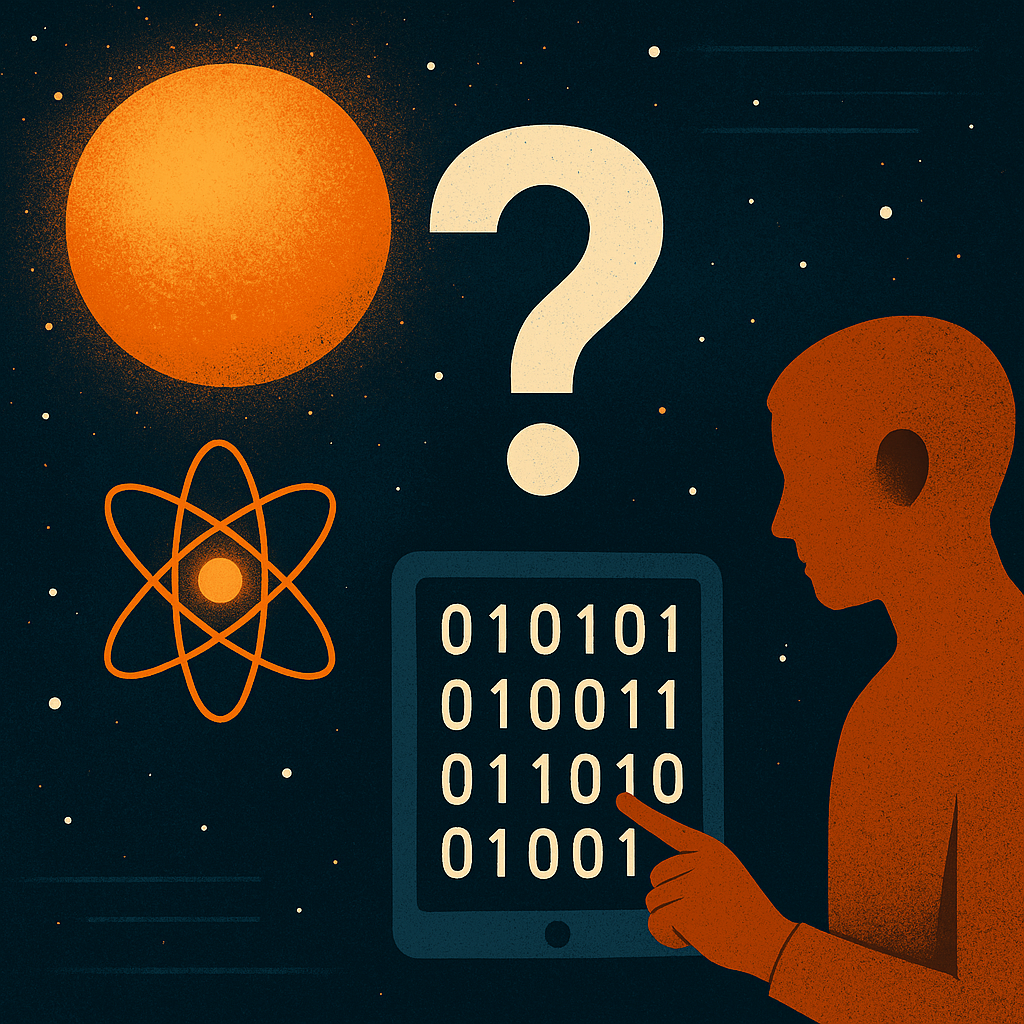
You check your phone and see a notification. Tap or ignore. Yes or no. That tiny choice decides what you see next, which ad appears, and which song autoplays. John Archibald Wheeler, a physicist with a flair for bold ideas, argued that the universe itself works a bit like that. He claimed every “it” in the world—particles, fields, even space and time—gets its meaning from “bits,” the simple yes-no answers our measurements pull from nature. He called it “it from bit,” and he thought observer participation is not a footnote, but the starting point. 

According to Wheeler, an experiment is like asking nature a clear question and writing down a clean answer. No question, no answer. When a detector clicks, we often say “a photon did it,” but what we truly have is a recorded yes-no event, a single bit that makes the story real for us. In another example, turning on a hidden magnetic field shifts an interference pattern; the shift is again read as counts—yes–no answers that reveal the field. Even black holes, the ultimate cosmic mystery, carry “entropy” that can be read as the number of hidden bits about how they were formed. Everyday version? Think of scanning a ticket at a concert: the gate doesn’t “know” you until your QR code returns a yes. The event becomes real for the system at the moment of that verified click. 

Wheeler also lays down four shake-ups: no infinite “turtles all the way down,” no eternal prewritten laws, no perfect continuum, and not even space and time as basic givens. He urges a loop: physics gives rise to observer-participancy, which gives rise to information, which then gives rise to physics. Meaning isn’t private; it’s built through communication—evidence that can be checked and shared. That’s why the past, in this view, is what’s recorded now; our arrangements today decide which path that ancient photon “took” when we finally measure it. In daily life, that’s how group chats settle plans: until a poll closes, there is no fixed “Friday plan.” Once the votes (bits) are in, the plan (the “it”) exists for everyone. 

So what’s useful here? First, ask better questions. The choice of question shapes what you have the right to say about the world. Second, respect the click—the simple, reliable bit—because significant patterns grow from countless small answers; “more is different” when many bits combine. Third, remember that meaning needs community. A claim doesn’t count until others can check the evidence. In short, your everyday yes-no choices—what you measure, share, and record—are not trivial. They’re how reality, in Wheeler’s sense, gets built, from the lab to your life.

Reference:
Wheeler, J. A. (1990). Information, Physics, Quantum: The Search for Links. In Feynman and Computation (pp. 309–336). CRC Press. https://doi.org/10.1201/9780429500459-19

Privacy Notice & Disclaimer:
This blog provides simplified educational science content, created with the assistance of both humans and AI. It may omit technical details, is provided “as is,” and does not collect personal data beyond basic anonymous analytics. For full details, please see our Privacy Notice and Disclaimer. Read About This Blog & Attribution Note for AI-Generated Content to know more about this blog project.
How Flies Read the World—And What That Teaches Us About Signals

Imagine biking downhill with the wind in your face. Everything is moving fast, yet you still dodge potholes and react in a blink. Your brain is turning bursts of electrical “pings” from your eyes into smooth, useful information about motion. That everyday magic—making sense from quick spikes—is exactly what Bialek and colleagues set out to understand. They flipped the usual lab view. Instead of asking how a known picture makes a neuron fire on average, they asked how a living creature could decode a short, one-off burst of spikes to figure out an unknown, changing scene in real time. They showed it’s possible to “read” a neural code directly, not just describe it in averages. 

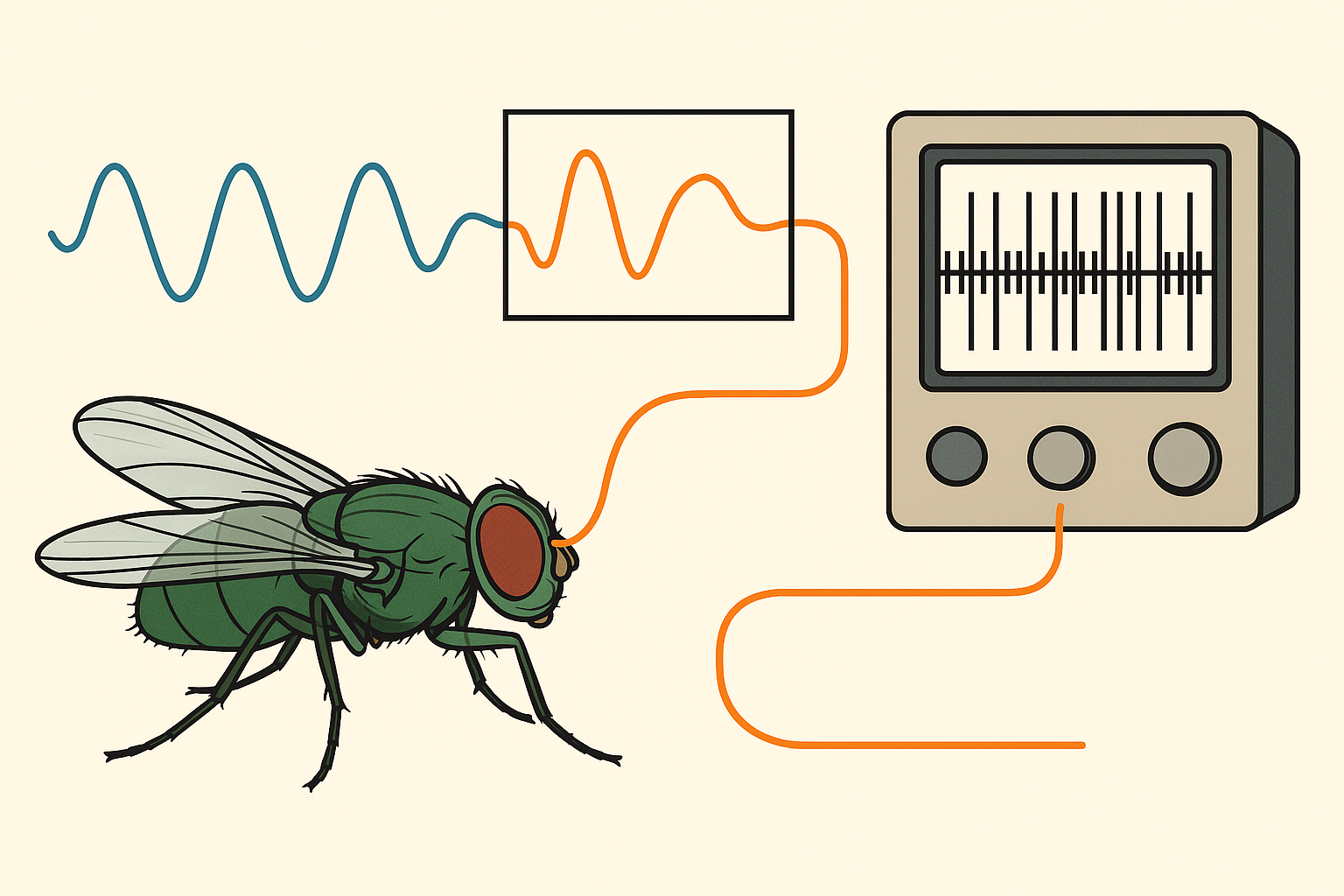
According to Bialek and colleagues, the classic “firing rate” concept is an average over many repetitions or across many cells. Real life rarely gives you that luxury. You usually get one noisy shot. So they focused on decoding from a single spike train, as an organism must do on the fly—literally. In the blowfly’s visual system, a motion-sensitive neuron called H1 feeds fast flight control. With only a handful of neurons in that circuit, the animal can’t compute neat averages; decisions rely on just a few spikes. The team’s key move was to replace rate summaries with a real-time reconstruction of the actual motion signal from those spikes. 

Here’s how they put it to the test. The fly viewed a random moving pattern whose steps changed every 500 microseconds, while the researchers recorded H1’s spike times. Then they built a decoding filter to turn spikes back into the motion waveform. To make it realistic, they required the filter to be causal and studied the tradeoff between speed and accuracy: waiting a bit longer improves the estimate, but you can’t wait forever if you need to act. Performance rose with delay and then leveled off around 30–40 milliseconds—right around the fly’s behavioral reaction time. The reconstructions were strong across a useful bandwidth, with errors that looked roughly Gaussian rather than systematic. Best of all, the neuron achieved “hyperacuity”: with one second of viewing, the motion could be judged to about 0.01°, far finer than the spacing of photoreceptors and close to theoretical limits set by the input itself. 

Why does this matter for your daily life? First, simple tools can decode rich signals: a straightforward linear filter turned spikes into motion with surprising fidelity. Second, quick decisions don’t require tons of data; a brief ~40 ms window and a few spikes can convey what matters, which is why “firing rate over time” isn’t always the right mental model. Third, robust systems tolerate minor timing errors; the code still works even when spike times are nudged by a few milliseconds. In short, smart decoding beats brute averaging, waiting just long enough maximizes usefulness, and good designs are fault-tolerant. That’s a handy recipe for studying, sports, or any fast choice you make under uncertainty. And yes—this work demonstrates that we can literally read a neural code in real-time.

Referencia:
Bialek, W., Rieke, F., de Ruyter van Steveninck, R. R., & Warland, D. (1991). Reading a Neural Code. Science252(5014), 1854–1857. https://doi.org/10.1126/science.2063199

Privacy Notice & Disclaimer:
This blog provides simplified educational science content, created with the assistance of both humans and AI. It may omit technical details, is provided “as is,” and does not collect personal data beyond basic anonymous analytics. For full details, please see our Privacy Notice and Disclaimer. Read About This Blog & Attribution Note for AI-Generated Content to know more about this blog project.
You Don’t Just Fit Your World—You Help Build It

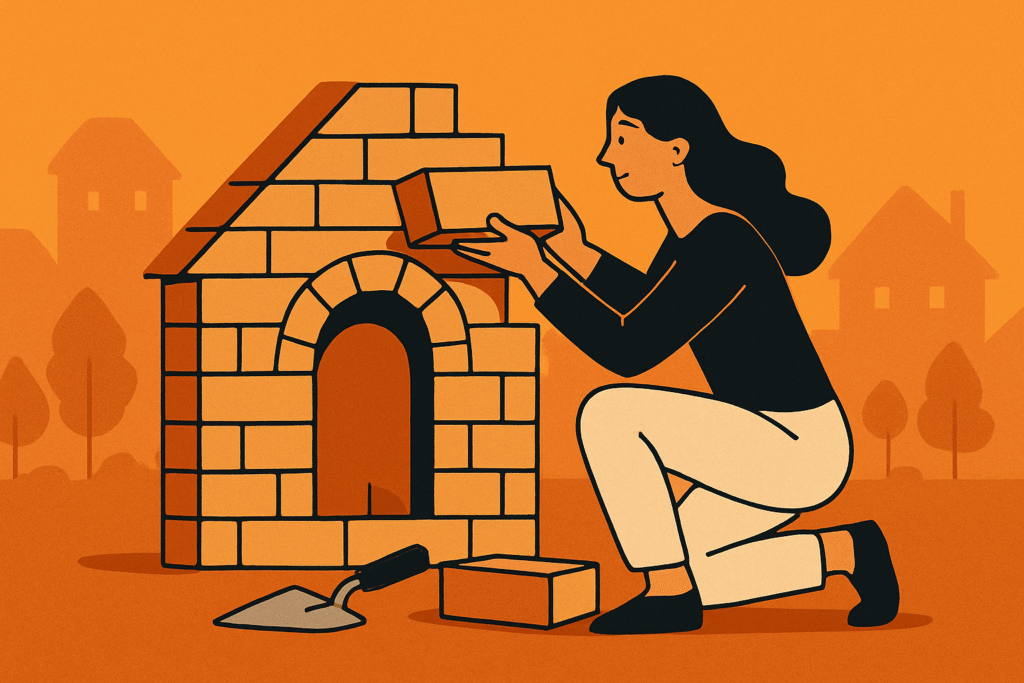
Imagine fixing up your room before exam week. You clear the desk, pin a schedule on the wall, and set a water bottle by your chair. A few days later, you’re studying longer, taking fewer breaks, and even sleeping better. Your tiny redesign didn’t just make the room nicer—it changed how you behave. Odling-Smee, Laland, and Feldman employ a similar concept for living things: organisms not only adapt to their surroundings, but also alter those surroundings in ways that matter for the future. They call this “niche construction,” and it means life is a two-way street between creatures and the environments they help shape.

According to the authors, animals and plants are constant remodelers. Worms mix and move soil so much that they alter its structure and chemistry over generations. Social insects build nests that later push the evolution of behaviors for keeping those nests safe, clean, and at the right temperature. Even plants tweak the world by shifting soil nutrients, humidity, or fire patterns, and some species evolve to rely on the very conditions they helped create. In everyday terms, it’s like generations of students leaving better notes, habits, or clutter for the next class—what’s left behind shapes what’s likely to happen next.

This remodeling has consequences that go beyond genes alone. Parents and ancestors can pass down “ecological inheritance”—not just DNA, but altered surroundings that change what traits are useful. Think of a cuckoo laying eggs in a host’s nest: that parental choice hands the chick a different set of challenges and advantages, which can steer which traits thrive. Sometimes there’s a delay: one set of genes changes the environment first, and only later do other genes catch up, creating “evolutionary momentum.” There are also indirect gene interactions: what one species does can change how another’s genes show up, like worms improving soil in ways that boost plant growth. For a human-scale analogy, a campus that adds more bike lanes may, over time, favor students who invest in cycling gear and habits—choices today shaping which skills and tools pay off tomorrow.

The big takeaway is practical: shaping your surroundings is part of shaping yourself. The authors even note that learned and cultural behaviors can initiate new selection pressures—such as birds learning to open milk bottles, which could make digestive or learning traits more valuable. Mutual “win-wins” can also start as by-products: animals that spread seeds while eating fruit help plants, nudging both sides to lean into the partnership. In daily life, curate your “niche” on purpose: set up study spaces that invite focus, pick routines that make healthy choices the easy default, and build group norms that future-you will inherit. Adaptation isn’t only about coping with what’s out there; it’s also about the feedback loops you create through what you build, protect, and pass on.

Reference:
Odling-Smee, F. J., Laland, K. N., & Feldman, M. W. (1996). Niche Construction. The American Naturalist, 147(4), 641–648. https://doi.org/10.1086/285870

Privacy Notice & Disclaimer:
This blog provides simplified educational science content, created with the assistance of both humans and AI. It may omit technical details, is provided “as is,” and does not collect personal data beyond basic anonymous analytics. For full details, please see our Privacy Notice and Disclaimer. Read About This Blog & Attribution Note for AI-Generated Content to know more about this blog project.
Why Big Animals Eat Less (Per Kilo) And Other Weird-But-True Body Rules

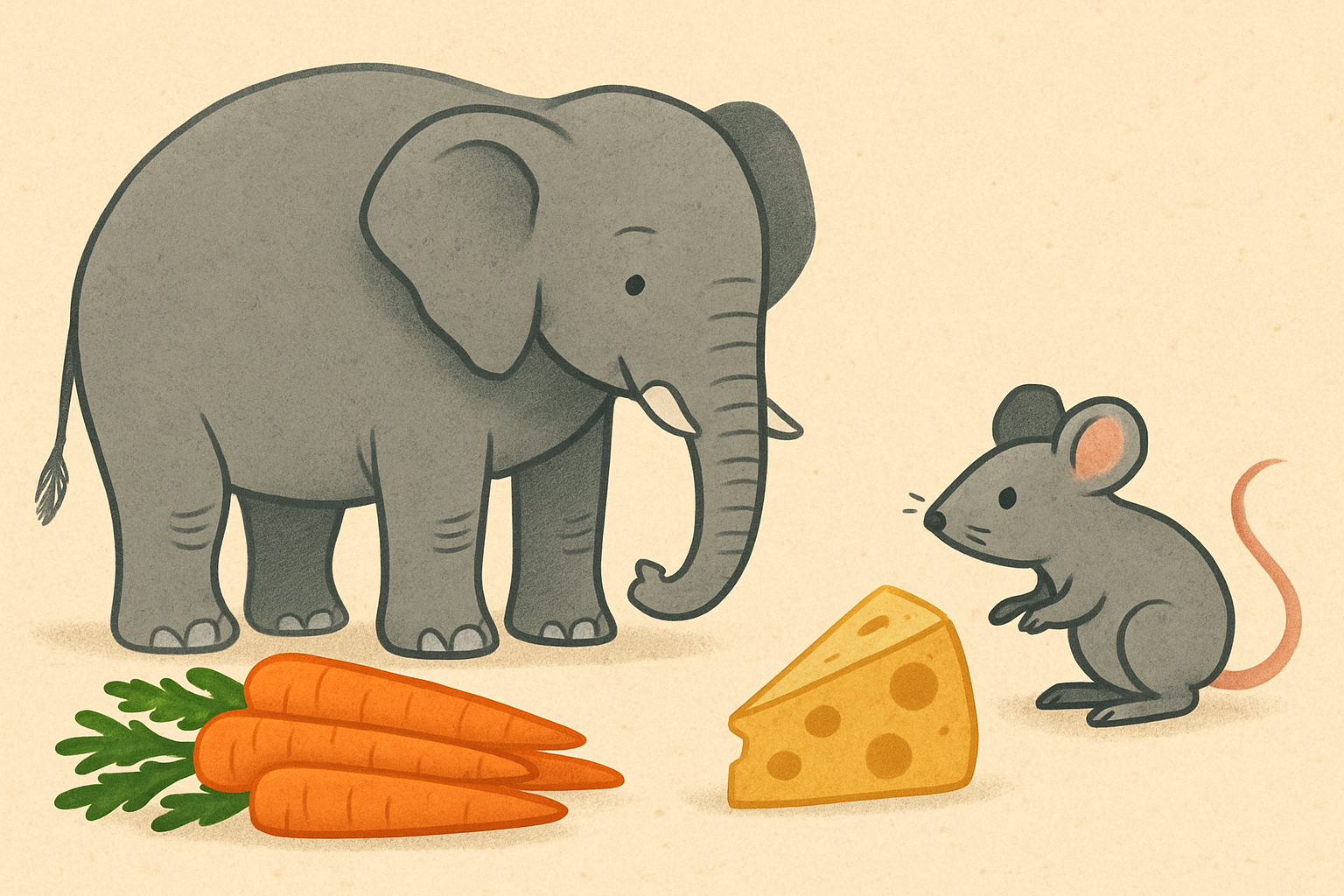
Ever wonder why a mouse seems to snack nonstop while an elephant can take its time? West, Brown, and Enquist explain that many things in living creatures follow simple size rules. As animals grow larger, their total energy use increases, but not at the same rate as their body mass. That’s why a small pet burns way more energy per kilogram than you do. Heartbeats and breaths follow the same pattern: smaller bodies tick faster, while bigger bodies tick slower. Even though long things, such as circulating blood or growing, tend to stretch with size.

The reason sits inside our plumbing. Life runs on networks of branching tubes that reach everywhere: your arteries and airways, the veins in a leaf, even the tiny pipes in an insect. These networks spread out like a fractal tree, splitting and splitting until they reach the tiniest units that actually do the job—capillaries in us, alveoli in lungs, fine vessels in plants. According to the authors, the end units remain approximately the same size across species, and the entire network is designed to utilize as little energy as possible. From those simple ideas, the size rules just… fall out.

This helps make sense of everyday stuff. A hamster needs frequent meals because its fast-beating heart and speedy breathing burn fuel quickly, while a cow can graze slowly because its network moves resources more calmly. Blood pressure stays about the same across sizes, but total blood volume scales with body size, so bigger animals carry more fuel on board. Lungs fit the story too: as bodies grow, the number of tiny air sacs increases a lot, but each sac’s size changes only a little. The result is a huge total surface for gas exchange without wasting energy pushing air around.

Once you notice these patterns, you see them everywhere. Tree trunks and aortas expand in size in a similar manner. Tiny creatures live life in fast-forward, big ones in slow motion, because their delivery networks set the pace. You don’t need equations to use this idea: it’s enough to remember that branching networks plus smart energy use create smooth scaling rules. That’s why animals of all sizes—from shrews to whales—play by the same hidden design, just at different speeds.

Reference:
West, G. B., Brown, J. H., & Enquist, B. J. (1997). A General Model for the Origin of Allometric Scaling Laws in Biology. Science, 276(5309), 122–126. https://doi.org/10.1126/science.276.5309.122

Privacy Notice & Disclaimer:
This blog provides simplified educational science content, created with the assistance of both humans and AI. It may omit technical details, is provided “as is,” and does not collect personal data beyond basic anonymous analytics. For full details, please see our Privacy Notice and Disclaimer. Read About This Blog & Attribution Note for AI-Generated Content to know more about this blog project.

The “Middle Way” of Nature: Where Big Patterns Come from Small Parts

We’re often told that if you know the tiny rules, you can predict everything. But that’s not how the world always works. Laughlin et al. argue that when lots of pieces come together, new patterns appear that don’t depend on every little detail. They call these “protected” behaviors—stable, reliable patterns, such as magnetism or superfluid flow — that appear repeatedly across different materials. You can’t easily compute them by tracking every atom; instead, you spot them by looking for the collective rules that emerge when many parts interact. In other words, between the world of atoms and the everyday world, there’s a “middle” zone where organization pops up on its own.

This middle zone shows up in living things and in everyday materials. Proteins don’t just sit there; they fold into useful shapes, pick out the right molecules to work with, and even team up to build structures—like a tiny construction crew that knows the plan. Glasses—think phone screens or plastic—can “age,” remember, and change slowly even when their atoms don’t look very different under x-rays. Soap-like molecules naturally form into bubbles and membranes, much like cell walls. And in some electronic materials, charges arrange themselves into stripes or domains that behave in surprising ways. All of this says the same thing: when enough pieces interact, they organize, and the result can be smarter than any single part.

How does this organization happen? One helpful picture is the “energy landscape.” Imagine a map of hills and valleys that indicates which shapes or arrangements are easier or harder for a system to reach. Some landscapes are rugged, with many similar valleys, so the system can get stuck in different long-lived states. Others are like a funnel that guides you toward one best shape—this is how many natural proteins fold quickly and reliably, because their landscapes gently steer them to the right place. Another big idea is “frustration,” which occurs when different forces want different things at the same time, such as in a group project with conflicting goals. That conflict can create patterns—such as domains, droplets, or stripes—as a compromise. Seeing problems this way helps you expect slow changes, memory effects, and multiple outcomes, rather than a single perfect answer.

Why should you care? These ideas make everyday choices easier. When a task involves many moving parts—planning an event, training a team, organizing your study schedule—don’t expect one tiny tweak to predict everything. Look for the protected patterns: routines that stay stable even when details change. Build funnels: set up habits and checklists that guide you toward the good outcome from many starting points. Expect frustration: competing goals will create trade-offs, so design simple “rules of thumb” everyone can follow. And be patient with “aging” and “memory”: systems often change slowly, keep history, and need time to reorganize. Scientists are developing new tools to see this middle world more clearly—like advanced microscopes and smart scattering methods—because understanding these rules won’t just explain cells and materials; it could help us design artificial systems that adapt and learn. That mindset can help you build projects, communities, and even personal routines that work with complexity instead of fighting it.

Reference:
Laughlin, R. B., Pines, D., Schmalian, J., Stojkovic, B. P., & Wolynes, P. (1999). The middle way. Proceedings of the National Academy of Sciences (PNAS), 97(1), 32–37. https://doi.org/10.1073/pnas.97.1.32

Privacy Notice & Disclaimer:
This blog provides simplified educational science content, created with the assistance of both humans and AI. It may omit technical details, is provided “as is,” and does not collect personal data beyond basic anonymous analytics. For full details, please see our Privacy Notice and Disclaimer. Read About This Blog & Attribution Note for AI-Generated Content to know more about this blog project.