Your Immune System Is Basically a Group Chat (With Rules)

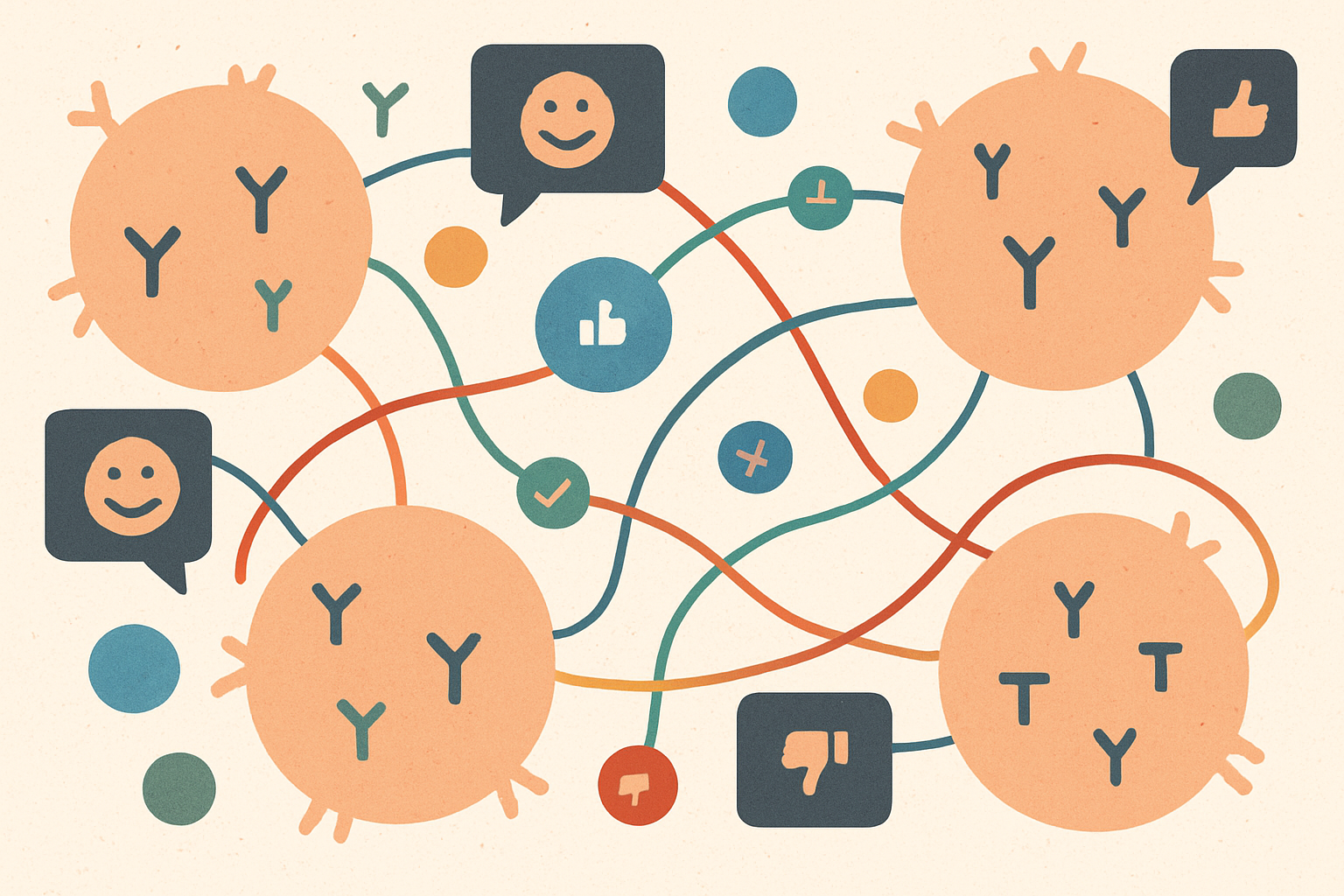
Picture a busy group chat when someone drops surprising news. A few people react, others reply to those replies, and suddenly the whole thread lights up. Perelson describes our immune system in a similar way: antibodies and immune cells “talk” to each other, sending excitatory and inhibitory signals across a network first imagined by Niels Jerne. In Jerne’s simple math sketch, each kind of cell can be nudged up or down by others—like replies that either hype or hush the chat. That idea sparked decades of research to understand how such a conversation remains helpful, rather than spiraling into chaos. 

To see why your body can recognize so many different “news items,” Perelson uses “shape space,” a way to picture how well antibodies fit what they’re trying to bind. Imagine a giant dartboard where every throw lands somewhere; each antibody covers a small circle around its spot, so a handful of well-placed circles can cover most of the board. With reasonable numbers, that coverage becomes impressively comprehensive: as the repertoire of different antibodies grows to around a million, almost every random target is identified. It’s a neat takeaway for everyday life: your immune system doesn’t rely on one perfect key—it keeps a messy but effective key ring so something usually fits. 

However, a giant group chat can become overwhelming. Here’s the clever part: Perelson shows there’s a “phase transition,” a tipping point where connections suddenly link up so well that a signal can ripple almost everywhere. Using a simple lattice argument, he explains there’s a critical threshold for connectivity; below it, messages fade in small clusters, above it, they can sweep the network. Practically, that means your immune system is wired to catch threats, but it also needs brakes so it doesn’t overreact to every ping. In animals, estimates suggest the expressed repertoire sits on the “highly connected” side—powerful, but in need of good control. 

So how does the chat stay useful? Perelson and colleagues argue for balance: stable, but not too stable. Too rigid and you miss important alerts; too twitchy and you burn out. Their shape-space models show patterns form best when activation is specific and nearby, while inhibition is broader—think close friends who nudge you, plus a quieter, system-wide “let’s chill” tone to avoid chaos. That balance also helps explain immune memory: some clones can stay elevated without constant drama from the rest of the network. For daily life, the message is clear: your body’s defenses work through diversity, smart thresholds, and healthy restraint—built to learn, remember, and react without turning every notification into an alarm.

Reference:
Perelson, A. S. (1989). Immune Network Theory. Immunological Reviews110(1), 5–36. https://doi.org/10.1111/j.1600-065X.1989.tb00025.x

Privacy Notice & Disclaimer:
This blog provides simplified educational science content, created with the assistance of both humans and AI. It may omit technical details, is provided “as is,” and does not collect personal data beyond basic anonymous analytics. For full details, please see our Privacy Notice and Disclaimer. Read About This Blog & Attribution Note for AI-Generated Content to know more about this blog project.


Letting Go vs Holding On: What Your Rhythm Says About Your Mind

You’re clapping along to a song with a friend. The beat speeds up. Without planning it, your hands switch from alternating claps to clapping together, just to keep up. Scientists observed the same phenomenon in simple lab tasks, where participants moved their fingers in response to a metronome. As the pace increased, one pattern transitioned into another and didn’t revert immediately, revealing two fundamental ways of moving and a natural “one-way” switch between them. 

According to Kelso, this flip isn’t just about muscles; it also reveals something about intention. In the classic experiments, participants were instructed to “do not intervene”—if the movement started to change, let it. That instruction makes any change count as “spontaneous,” and yet it also acts like a mental nudge to “let go.” The result is that tiny wobbles in the rhythm grow and help trigger the switch. Kelso calls these wobbles “fluctuations,” and he argues they can reflect your intention, not just random noise. In everyday terms, choosing to let the pattern change or to hold it steady is evident in those small timing shifts. 

Here’s the twist: telling yourself to “hold on” changes those wobbles. People can maintain a stable pattern for longer when they intend to, meaning the shape and size of the fluctuations adjust in accordance with their goal. That’s why Kelso says intention may be “hidden in the fluctuations.” As speed increases, those fluctuations typically swell before a switch (a hallmark of being near a change), and settling down can take longer as well. Think of cranking up the tempo on a workout track: the closer you get to your limit, the shakier it feels, and it takes a moment to steady yourself. 

Why does this matter for daily life? Because the same idea links body and mind. Kelso suggests we don’t need extra knobs in the theory to explain intention; the boundary conditions—your simple rule to yourself like “let go” or “hold on”—already tune the fluctuations. Once a switch occurs, systems often don’t revert right away, much like the momentum in your habits. That’s hysteresis in action. This dance between stability and change also shows up as we learn and explore, from finding a new rhythm to the way babies discover what their actions can do. In short, tiny changes in your timing can be purposeful signals of what you mean to do—and that’s a practical reminder that setting a clear rule for yourself can gently steer your mind and your moves.

Reference:
Kelso, J. A. S. (2025). The motionable mind: How physics (dynamics) and life (movement) go(t) together—On boundary conditions and order parameter fluctuations in Coordination Dynamics. The European Physical Journal Special Topics. https://doi.org/10.1140/epjs/s11734-025-01875-7

Privacy Notice & Disclaimer:
This blog provides simplified educational science content, created with the assistance of both humans and AI. It may omit technical details, is provided “as is,” and does not collect personal data beyond basic anonymous analytics. For full details, please see our Privacy Notice and Disclaimer. Read About This Blog & Attribution Note for AI-Generated Content to know more about this blog project.
What Actually Makes Young People in Mexico Feel Happy?

You’re on the bus after class, scrolling WhatsApp, checking a meme on Instagram, and wondering if being “happier” is about more likes, more money, or just more sleep. Romero-Gómez and colleagues examined real data from Mexico to determine what matters most, using the national well-being survey. They found something simple yet powerful: most people report being fairly happy—an average of 8.45 out of 10, with about two-thirds falling within the 8–10 range. That’s a good baseline to start from and a reminder that many everyday lives already include plenty of reasons to feel okay.

According to Romero-Gómez et al., happiness isn’t one big thing; it’s a mix of your money and health situation, your mind, and your online connections. Messaging apps like WhatsApp and Telegram are an integral part of daily life for more than half of the people surveyed, while TikTok, Twitter, and Instagram are used less frequently in this sample. Picture a normal day: you swap voice notes with your family, share a quick update in a class group, and laugh at a short video. That small stream of connection helps—but it isn’t the main driver. In their model, social networks had a positive but modest link with happiness, while socioeconomic factors (how safe you feel, how you rate public services, your health, and the economy) did much more of the heavy lifting. Psychological strain, like stress, anxiety, or feeling down, pushed happiness in the opposite direction.

So, what’s useful day-to-day? First, care about the basics you can influence. If you’re juggling a part-time job and school, planning your budget, sleeping enough, and staying on top of a health check can pay off in how you feel. That aligns with the finding that better ratings of health, the economy, safety, and public services are associated with higher happiness. Safety and services are areas where many people feel less satisfied, which is important to consider when choosing a neighborhood, commute route, or campus service to use. Second, use your feeds like tools, not traps. A couple of chats that make you feel supported can help; doom-scrolling when you’re already anxious won’t. In the numbers, psychological factors had a clear negative impact, so noticing early signs—trouble concentrating, feeling nervous, and sadness that persists—and talking to someone is not just “mental health talk”; it’s practical happiness math.

Here’s the bottom line from Romero-Gómez and colleagues: start with the pillars, then add the polish. Socioeconomic factors show the strongest positive link with happiness; social networks add a small boost; psychological strain pulls it down. In their results, the model explained about a third of what makes people feel happier, which is a lot in real life. So yes, keep the group chat alive. Also, take that free clinic appointment, pick the safer bus stop, and set a bedtime you actually keep. Small moves add up. And if you’re having a rough stretch, that’s common, too—many people report stress or anxiety at least sometimes. Getting support is not a luxury; it’s one of the fastest ways to improve your mood this week.

Reference:
Romero-Gómez, D., Ahumada-Tello, E., Evans, R., & Castañón-Puga, M. (2024). Exploring the determinants of happiness in Mexico: The interplay of social networks, psychological well-being, and socioeconomic factors. Transactions on Energy Systems and Engineering Applications, 5(2). https://doi.org/10.32397/tesea.vol5.n2.636

Privacy Notice & Disclaimer:
This blog provides simplified educational science content, created with the assistance of both humans and AI. It may omit technical details, is provided “as is,” and does not collect personal data beyond basic anonymous analytics. For full details, please see our Privacy Notice and Disclaimer. Read About This Blog & Attribution Note for AI-Generated Content to know more about this blog project.
AI at Work: Stress, Help, or Both?

You land your first job and your manager asks you to try a new AI tool. Part of you is excited; part of you worries about mistakes, pressure, or privacy. Ahumada-Tello and colleagues looked at these everyday doubts using worker data from OECD countries to see how AI actually relates to happiness at work and to the choices people make on the job. They used survey data and factor analysis to study the links between AI use, decision-making, and well-being, finding patterns across hundreds of workers. 

According to the authors, the big picture is encouraging: AI, on average, does not lower happiness. It tends to support better and faster decisions, which can feel good when your to-do list is long. In the survey, most people agreed AI improves decisions and speeds them up, showing how tools can cut busywork so you focus on real problems. Picture an intern using AI to group customer messages so the team answers faster and with fewer errors—that is the kind of help many respondents reported. The study also organized AI at work into five practical areas: worries about AI, help with decisions, general use, managing AI teams, and working directly with AI systems. 

The authors dig into a surprising point: worries about AI—like job security, data, or losing control—did not automatically make people less happy. In fact, for some, noticing the risks pushed them to adapt, learn new skills, and feel more in control again. At the same time, the study highlights limits and conditions. Trust and transparency matter when algorithms are involved, and some jobs still need human empathy and flexibility that tools cannot replace. Imagine a chatbot helping with routine questions while a person handles sensitive cases; that mix fits what the researchers describe. 

So what should a young worker take from this? In this study, using AI, getting help from it in decisions, and integrating it into daily tasks were all linked with higher happiness at work. The drivers behind that lift are very down-to-earth: adaptability, efficiency, a sense of mastery, leadership opportunities, and clarity about what to do next. In simple terms, learn the tools, keep your human skills sharp, and ask for clear explanations when AI is used. That way you get the speed boost without losing yourself in the process.

Referencia:
Ahumada-Tello, E., Evans, R. D., Romero-Gómez, D., López-García, J., & Castañón-Puga, M. (2023). The impact of AI on the workplace: OECD AI surveys of employers and workers. 2023 IEEE Global Conference on Artificial Intelligence and Internet of Things (GCAIoT), 121–126. https://doi.org/doi:10.1109/GCAIoT61060.2023.10385121.

Privacy Notice & Disclaimer:
This blog provides simplified educational science content, created with the assistance of both humans and AI. It may omit technical details, is provided “as is,” and does not collect personal data beyond basic anonymous analytics. For full details, please see our Privacy Notice and Disclaimer. Read About This Blog & Attribution Note for AI-Generated Content to know more about this blog project.

Smarter Choices, Better Ideas: How to Make Decisions and Innovate Like a Pro

Big choices don’t just happen; they follow a simple path. First, notice that a decision needs to be made. Then gather solid info from inside and outside your world. List your options, weigh the evidence, pick one, act, and later assess the outcome. That’s the whole loop, and doing it on purpose makes success more likely. Ahumada-Tello et al. explain this step-by-step process and stress the importance of using reliable data at each stage to avoid guesswork. Today, there’s a flood of data to help you: from basic spreadsheets to tools like data mining and business intelligence. Used well, these don’t replace your judgment—they sharpen it.

Innovation isn’t only about inventing the next smartphone. It can be a new product you can touch, a new service you experience, or a better way to do the work behind the scenes. Consider a supermarket that introduces home delivery (service), a store transitioning from paper forms to digital dashboards (process), or phones that continually add features year after year (product). Changes can be small or huge. Rebranding a snack is incremental. Jumping from older mobile networks to 3G or 4G was revolutionary because it reshaped what phones could do and how the entire industry operated. Sometimes the change is to a single part (modular), like swapping a camera lens. At other times, the entire setup is re-wired (architecturally), such as the transition from film to digital cameras, which altered how every piece fits together.

So what matters most for a team’s results? In a study of tech firms in Tijuana, researchers found that clear, professional decision-making had the strongest link to better organizational performance, even more than new-product work or innovation programs. In their model: Performance = −4.876 + 0.152×New Product Development + 0.102×Innovation Management + 0.403×Decision-Making Process. That big 0.403 shows decision-making packs the biggest punch. The takeaway is simple: learn to structure choices, manage information well, and you’ll boost your outcomes—even before you launch the next big feature.

How do you put this into practice day-to-day? Start small. When you’re picking a class, a side hustle, or a project idea, run the mini-cycle: define the problem, collect relevant info, list options, rate the pros and cons, decide, act, and review what you learned. Use easy data sources—such as surveys, quick tests, or simple dashboards—to keep emotions from steering the ship. Then look for innovation sweeps you can actually do: a smoother process for your study group, a fresh service twist for your freelance gig, or a tiny product upgrade that delights people. Small, steady improvements build momentum, and when a radical opportunity appears, you’ll be ready to make a confident call backed by a clear process.

Reference:
Ahumada-Tello, E., Castañón-Puga, M., Gaxiola-Pacheco, C., & Evans, R. D. (2019). Applied decision making in design innovation management. In Studies in Systems, Decision and Control (Vol. 209). https://doi.org/10.1007/978-3-030-17985-4_5

Privacy Notice & Disclaimer:
This blog provides simplified educational science content, created with the assistance of both humans and AI. It may omit technical details, is provided “as is,” and does not collect personal data beyond basic anonymous analytics. For full details, please see our Privacy Notice and Disclaimer. Read About This Blog & Attribution Note for AI-Generated Content to know more about this blog project.