How Random Molecules Might Have Sparked the First Life

Imagine you’re sitting at your desk with a messy pile of LEGO bricks. You’re not trying to build anything specific. Still, every so often, pieces snap together in a way that unexpectedly resembles something recognizable—a tiny house, a creature, or a spaceship. Now, picture that instead of LEGO bricks, you have thousands of small molecules floating around on a particle or droplet somewhere on early Earth. According to Dyson, a similar process may have happened billions of years ago: random molecules bumping into each other until, by pure chance, some formed structures that helped create more structures like themselves.

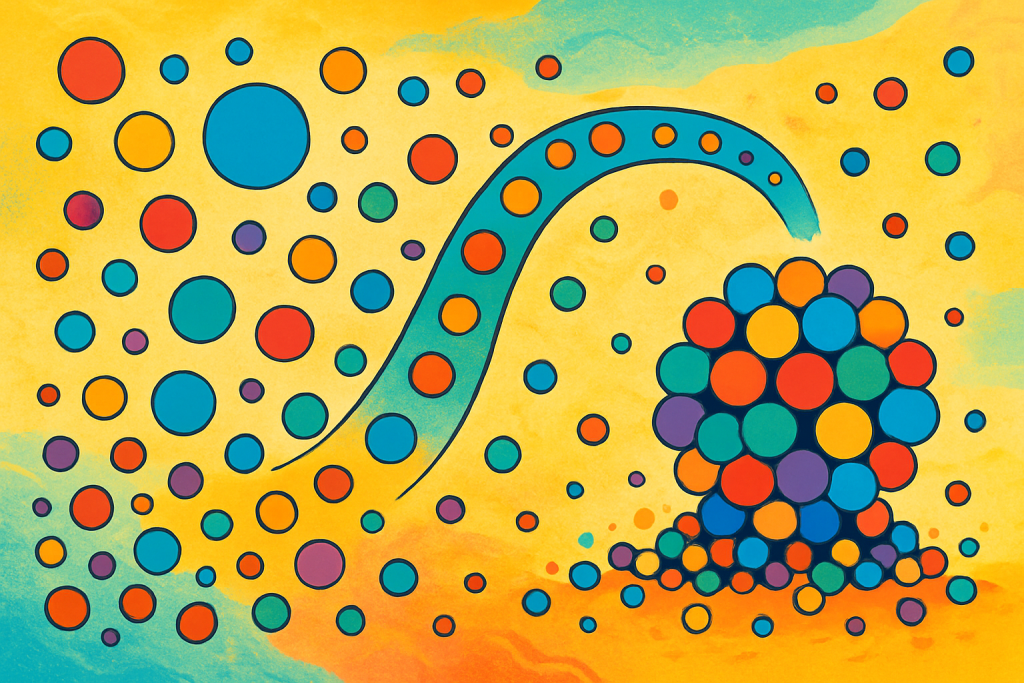
The idea Dyson describes is that life didn’t begin with a perfect genetic system, such as DNA, but with small ‘islands’ of molecules—clusters where a fixed number of monomers gathered and occasionally joined into tiny chains. Most of the time, these chains were useless, but every now and then, one of them would help another chain form. Dyson refers to those as ‘active’ monomers. When enough active ones appeared at once, a kind of order emerged: the molecules on the island became good at helping each other grow. To make this easier to imagine, think of a group of students working on a group project. If only one or two people are doing the work, not much happens. Still, if the group randomly ends up with several motivated people at the same time, suddenly the whole project becomes productive. Dyson’s model suggests that a similar team effect could have happened among primitive molecules.

Dyson’s calculations highlight that, even without natural selection, a small island of a few thousand monomers could have shifted from chaos to order through chance. Early life may have begun as a random event that stabilized once sufficient beneficial molecules accumulated. Dyson describes this early ‘ordered state’ as a messy mix of simple catalysts rather than modern cells. Once such an island became ordered, it could grow, absorb more material, and eventually split into two, making natural selection relevant only later. The main point is that significant changes in nature—and in life—often begin with small, unlikely steps that become possible when many small things come together.

Reflecting on your own life, Dyson’s model offers a simple lesson. Order doesn’t always come from careful planning; sometimes it emerges from many small attempts, even failed ones, that eventually align. Just as those early molecules needed luck and numerous small fluctuations to reach a stable, productive state, young people often require time and space to try, adjust their direction, and gradually form habits that support growth. What matters is staying in the game long enough for your ‘active pieces’—your motivation, interests, and skills-to come together. Once they align, progress feels natural instead of forced, much like how Dyson suggests early life first found its order.

Reference:
Dyson, F. J. (1982). A model for the origin of life. Journal of Molecular Evolution18(5), 344–350. https://doi.org/10.1007/BF01733901

Privacy Notice & Disclaimer:
This blog provides simplified educational science content, created with the assistance of both humans and AI. It may omit technical details, is provided “as is,” and does not collect personal data beyond basic anonymous analytics. For full details, please see our Privacy Notice and Disclaimer. Read About This Blog & Attribution Note for AI-Generated Content to know more about this blog project.

How Simple Brain-Like Systems Learn and Remember

Imagine you’re trying to remember the name of a song. You don’t recall the whole thing—just a fragment of the melody or a single lyric. But somehow your brain fills in the rest, and the entire song suddenly pops into your mind. This everyday moment shows something powerful: even small bits of information can trigger complete memories. The document by Hopfield explains how elementary networks, made of many tiny “on/off” units, can behave in surprisingly brain-like ways and perform tasks like this without needing complicated programming.

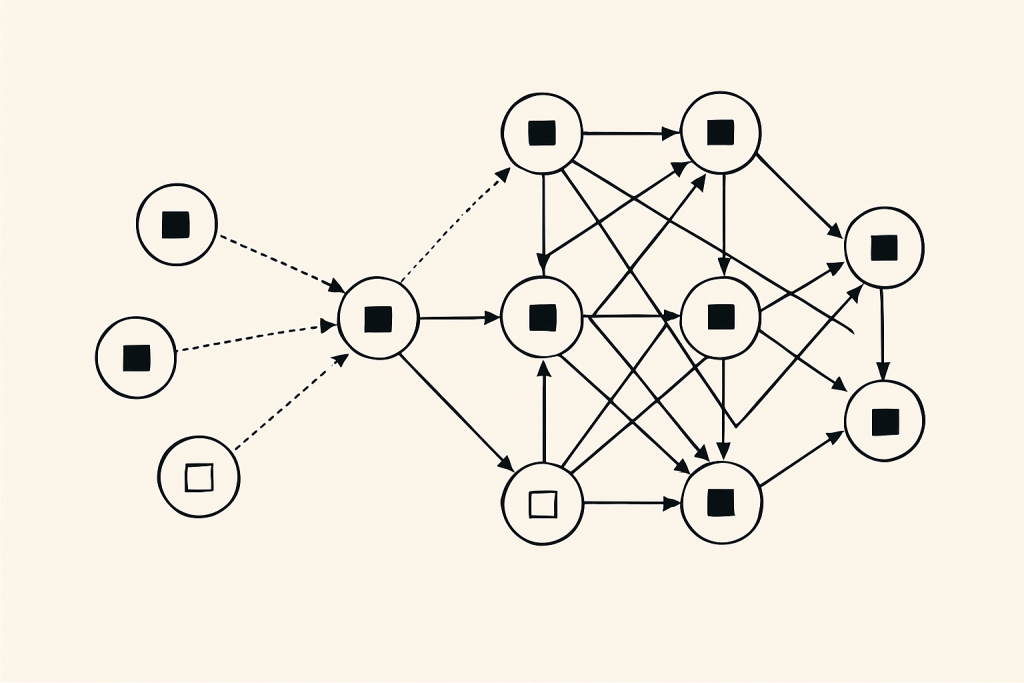
Hopfield and colleagues describe how a network of simple neurons—each capable of switching only between “on” and “off”—can work together to store memories and retrieve them when given partial hints. For example, if the network had learned several patterns, showing it only part of one pattern could make the whole system automatically “flow” toward the full version. This happens because the system creates stable states, like resting spots, that it naturally falls into. It’s similar to how a marble dropped on a bumpy surface always ends up in one of the low dips. If your starting point is close enough to a dip, the system finishes the job for you and returns the full memory.

What’s especially interesting is that these networks can correct small mistakes, sort confusing inputs into categories, and even recognize when something is unfamiliar. For instance, if the system is shown a pattern that doesn’t match any of the stored memories, it settles into a special “unknown” state, acting almost like a built-in warning that the input doesn’t fit anything it has seen before. The document also shows that the network continues to function even if some of its connections fail or if many memories are stored simultaneously; its performance slowly degrades rather than collapsing suddenly. This “fail-soft” behavior is rare in ordinary computer circuits but everywhere in biological systems.

The most surprising part is how all these smart behaviors don’t come from any single neuron being clever. Instead, they arise from the collective behavior of many simple units acting together. This idea matters beyond neuroscience. It suggests that powerful abilities—such as recognizing faces, learning patterns, or making quick decisions—can emerge from surprisingly simple parts working in parallel. For young people learning about technology and the brain, this demonstrates that intelligence doesn’t always require complexity at the most fundamental level. Sometimes, it’s the connections, the cooperation, and the way the whole system behaves that create something much more potent than the pieces alone.

Reference:
Hopfield, J. J. (1982). Neural networks and physical systems with emergent collective computational abilities. Proceedings of the National Academy of Sciences79(8), 2554–2558. https://doi.org/10.1073/pnas.79.8.2554

Privacy Notice & Disclaimer:
This blog provides simplified educational science content, created with the assistance of both humans and AI. It may omit technical details, is provided “as is,” and does not collect personal data beyond basic anonymous analytics. For full details, please see our Privacy Notice and Disclaimer. Read About This Blog & Attribution Note for AI-Generated Content to know more about this blog project.

When Simple Rules Create Surprising Chaos

Imagine you’re adjusting the volume on your speaker. You turn the knob a little, and the sound increases in volume smoothly. Now imagine a different knob—one where a tiny twist suddenly makes the music jump, echo, or even break into unpredictable noise. That second knob is similar to what occurs in many natural systems. Things seem calm, but then they suddenly start behaving in strange and unexpected ways. This jump from simple to chaotic behavior is precisely what Feigenbaum and colleagues explore in the attached document.

The authors explain that many systems in nature—from the flow of fluids to the growth of populations—don’t suddenly become chaotic for no reason. Instead, as a system’s control parameter changes (something like temperature, pressure, or population growth rate), its behavior shifts through a clear pattern: first it repeats every time step, then every two, then every four, then every eight, and so on. This repeated doubling is called period doubling. You can picture it like a bouncing ball that always hits the ground at the same rhythm, until you slowly change one condition. Suddenly, it needs two bounces to repeat, then four, then eight, and finally no simple rhythm at all. The remarkable aspect is that this route to chaos follows a universal pattern that appears everywhere, even in systems that seem entirely unrelated.

One of the most intriguing ideas in the document is that very different systems (such as liquid helium becoming turbulent or a mathematical function used in a random number generator) can behave almost identically as they approach chaos. The spacing between each stage of period doubling shrinks by the same factor every time. This constant number appears regardless of the system you study. That means that if you can observe how a straightforward model behaves, you can understand the behavior of much more complicated things in the real world. For a young person, this is like realizing that the trick behind a magic show works on every stage, not just the small one in your school auditorium.

What does this mean for everyday life? It suggests that unpredictability doesn’t always come from randomness—sometimes it comes from simple rules repeated over and over. Think of your favorite app recommending videos: one tiny change in what you watch can send you down an entirely different path, not because the system is random, but because minor differences snowball quickly. Or consider friendships, routines, or habits: small, repeated choices can lead to significant and sometimes surprising outcomes. The message from Feigenbaum’s work is that complexity has structure. Chaos has a pathway. And understanding that path helps us see patterns where we once saw only confusion.

Ultimately, this theory presents a hopeful perspective. When things feel messy or unpredictable, it doesn’t always mean they’re out of control. Sometimes, they’re just following a universal route toward a new kind of behavior. And knowing this can help us appreciate that even chaos has its own type of order.

Reference:
Feigenbaum, M. J. (1983). Universal behavior in nonlinear systems. Physica D: Nonlinear Phenomena7(1–3), 16–39. https://doi.org/10.1016/0167-2789(83)90112-4

Privacy Notice & Disclaimer:
This blog provides simplified educational science content, created with the assistance of both humans and AI. It may omit technical details, is provided “as is,” and does not collect personal data beyond basic anonymous analytics. For full details, please see our Privacy Notice and Disclaimer. Read About This Blog & Attribution Note for AI-Generated Content to know more about this blog project.

How Simple Rules Can Create Surprising Worlds

Imagine you’re doodling on squared paper during a long bus ride. You start by coloring a few squares randomly. Then you make up a rule: “If a square has two colored neighbors, color it next turn; otherwise leave it blank.” You move to the next row, applying the rule repeatedly. At first, it feels like nothing special. But suddenly, shapes appear—lines, triangles, even messy bursts that seem almost alive. That moment when order emerges from randomness feels magical, yet it follows from just a few simple steps.

According to Stephen Wolfram, whose work explores the hidden patterns behind these kinds of drawings—called cellular automata—this magic isn’t accidental. He explains that even elementary rules, when repeated repeatedly, can create four distinct “personalities” of behavior. Some rules calm everything down until all squares look the same. Others make small, repeating shapes that move or remain stationary. Some explode into chaos, filling the page with unpredictability. And a few very special rules mix order and chaos in a way so rich that they can even perform a kind of computation, similar to how a computer processes information.

To picture this, imagine baking cookies with four different cookie doughs. One dough always flattens into a smooth cookie, no matter what shape you start with—that’s like the rule that makes everything look uniform. Another dough always forms neat little bumps or rings—that’s the rule that creates simple repeating structures. A third dough spreads unpredictably, making patterns that never look the same twice—this is the chaotic dough. And finally, the fourth dough sometimes forms bumps, sometimes remains flat, and sometimes creates complex patterns that resemble miniature machines. Wolfram shows that this last type is potent because its results can’t be predicted without actually going step by step, just like running a program.

What makes this useful for everyday life is realizing how often simple rules create complex outcomes. Imagine a group chat where one person responds to a message, and then others react to that response. A tiny interaction can ripple outward and shape the whole conversation. Or think of routines: hitting “snooze” once might seem harmless, but repeated daily, it shapes your whole morning rhythm. Small rules, repeated over time, add up. Wolfram’s point is that complexity doesn’t always come from complicated instructions—it often comes from elementary ones applied consistently.

It’s also a reminder that not everything can be predicted just by analyzing the rules. Some processes (such as how ideas spread online, how habits form, or how friend groups evolve) can only be understood by observing them unfold. Wolfram’s fourth type of behavior teaches us that even if we know all the rules, we might still need to observe change step by step. That’s not a limitation—it’s an invitation to explore, experiment, and stay curious about the patterns that shape our daily lives.

Reference:
Wolfram, S. (1984). Universality and complexity in cellular automata. Physica D: Nonlinear Phenomena10(1–2), 1–35. https://doi.org/10.1016/0167-2789(84)90245-8

Privacy Notice & Disclaimer:
This blog provides simplified educational science content, created with the assistance of both humans and AI. It may omit technical details, is provided “as is,” and does not collect personal data beyond basic anonymous analytics. For full details, please see our Privacy Notice and Disclaimer. Read About This Blog & Attribution Note for AI-Generated Content to know more about this blog project.
Tiny Digital Worlds and the Question “What Is Life, Really?”

Imagine you open a simple app on your laptop: just a dark grid of tiny squares, like digital graph paper. You click a few cells to light them up, hit “play,” and suddenly the pattern starts to move. Dots travel across the screen, loops appear, some structures collide and disappear, others split and multiply. There’s no character, no storyline, no fancy graphics—only colored squares following basic rules. Yet, the screen feels strangely alive, like watching bacteria in a petri dish or traffic in a city from a great distance. Langton’s work asks a bold question about scenes like this: could something that looks and behaves “alive” emerge from nothing more than tiny, inanimate pieces obeying simple rules?

To explore that question, Langton uses what are called cellular automata, which can be visualized as video-game worlds composed of pixels that all update simultaneously. Each square on the grid decides what to do—stay dark, light up, change color—by checking only its neighbors. No central authority is dictating the grid’s actions; instead, it relies on local interactions. By changing a single “knob” that controls how easily cells become active, Langton shows that these worlds can freeze into stillness, explode into chaos, or settle into a balanced middle zone. In that middle zone, patterns are both stable and changing: little moving shapes glide around, collide, and leave trails. This is where things start looking uncannily like the way molecules interact in real cells, and it’s the region Langton finds most promising for “artificial life.”

Langton goes a step further and treats the moving patterns themselves as tiny digital machines, which he calls virtual automata or virtual state machines. They can store information in their shape, react to other patterns, and even build or erase structures on the grid. In his examples, some of these patterns play roles similar to biological molecules: they transport “stuff” by copying it elsewhere, regulate activity by keeping each other in check, or act as messengers that trigger changes in different patterns. Collections of them can behave like simple societies: for instance, virtual “ants” follow ultra-simple rules—turn left or right depending on the color of the cell they step on—yet together they carve out trails and web-like structures that look designed, even though no ant has a global plan. Langton also shows a compact loop that carries a tiny digital “recipe” circulating inside it; that recipe is used both to build a new loop and to copy itself, allowing the loop to reproduce again and again across the grid, much like a microscopic colony expanding in all directions.

Why should any of this matter in everyday life if you’re not a biologist or a programmer? Because it’s a concrete reminder that complex, meaningful behavior can grow from straightforward rules repeated many times, with no mastermind in charge. The way trends spread on social media, how traffic jams suddenly appear on a highway, or how habits slowly build your future self all share this vibe: many small actions, interacting locally, creating significant patterns that no one person designed. Langton and colleagues suggest that by studying artificial life in these tiny digital universes, we can better understand not only how real cells and organisms might work, but also how any system made of many simple parts—groups of friends, online communities, even your own daily routine—can tip from boring, to richly creative, to completely chaotic depending on how it’s “tuned.” Playing with these grid worlds, or just thinking in their terms, can train you to notice the small rules shaping your own life and maybe tweak them so your world stays in that sweet, lively middle zone where new, interesting things can emerge.

Reference:
Langton, C. G. (1986). Studying artificial life with cellular automata. Physica D: Nonlinear Phenomena22(1–3), 120–149. https://doi.org/10.1016/0167-2789(86)90237-X

Privacy Notice & Disclaimer:
This blog provides simplified educational science content, created with the assistance of both humans and AI. It may omit technical details, is provided “as is,” and does not collect personal data beyond basic anonymous analytics. For full details, please see our Privacy Notice and Disclaimer. Read About This Blog & Attribution Note for AI-Generated Content to know more about this blog project.