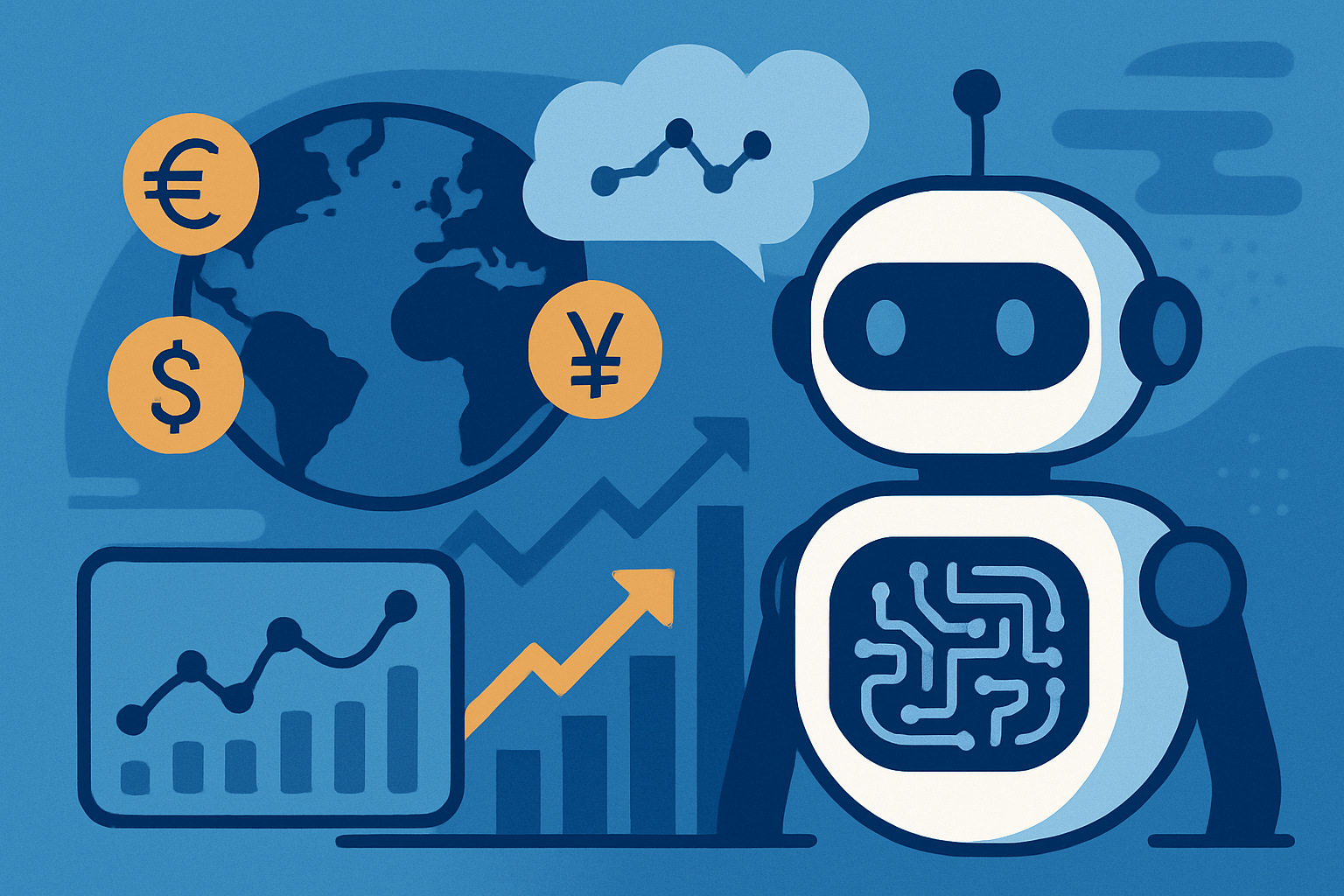
Smart Predictions, Simple Rules: How “Fuzzy” Agents Learn the Forex Mood

We all make decisions with shades of “maybe.” That’s the idea behind the system described by Hernandez-Aguila et al.: using fuzzy logic combined with a team of simple “agents” (think: virtual traders) to predict currency prices. Each agent follows clear rules and, importantly, can express doubt. This “intuitionistic” fuzzy logic allows a rule to not only indicate how much something is true, but also how much it isn’t—and how uncertain we are—so the model remains human-readable instead of a black box.

Here’s the twist that feels very real-life: the agents don’t have to act all the time. They use “specialization” thresholds to determine when market conditions resemble situations they are familiar with. If the match is weak, they sit out—just like you might skip riding a scooter on a rainy day. These thresholds coordinate the team: agents avoid trades where they’d likely do poorly, and the model only speaks up when it recognizes a strong pattern. In practice, the system ranks how strongly each input fits an agent’s rules and picks a cut-off (a depth level) that triggers action only in the most familiar scenarios.

Why bother with “fuzzy” in the first place? Because real data is messy. Instead of forcing a yes/no, fuzzy sets allow us to say “somewhat high” or “very low,” then convert many such shades into an output. Intuitionistic fuzzy sets go further by tracking non-membership and “hesitancy,” which captures doubt—useful for markets that change mood quickly. This combo keeps rules readable (“if the trend is high, then buy is high”) while acknowledging uncertainty, such as when you plan to study more when your focus feels “medium” and you’re unsure it’ll last.

Does it work? The authors tested their approach on major currency pairs and compared it with deep learning and other popular methods. Their errors (measured by mean absolute error) were in the same ballpark as those of state-of-the-art models, and using specialized agents helped performance. They also assessed the real-world impact by comparing their specialized models to a simple “buy and hold” approach over many years; their models performed better in terms of revenue. The takeaway for daily life is simple: clear, interpretable rules that know when to act—and when to pause—can rival the complexity of black boxes. Try adopting that mindset in your own decisions: define simple rules, acknowledge uncertainty, and act only when the pattern aligns.

Reference:
Hernandez-Aguila, A., Garcia-Valdez, M., Merelo-Guervos, J. J., Castanon-Puga, M., & Lopez, O. C. (2021). Using Fuzzy Inference Systems for the Creation of Forex Market Predictive Models. IEEE Access, 9, 69391–69404. https://doi.org/10.1109/ACCESS.2021.3077910

Privacy Notice & Disclaimer:
This blog provides simplified educational science content, created with the assistance of both humans and AI. It may omit technical details, is provided “as is,” and does not collect personal data beyond basic anonymous analytics. For full details, please see our Privacy Notice and Disclaimer. Read About This Blog & Attribution Note for AI-Generated Content to know more about this blog project.

Smarter “Maybes”: How Fuzzy Logic Helps Us Model Real Life

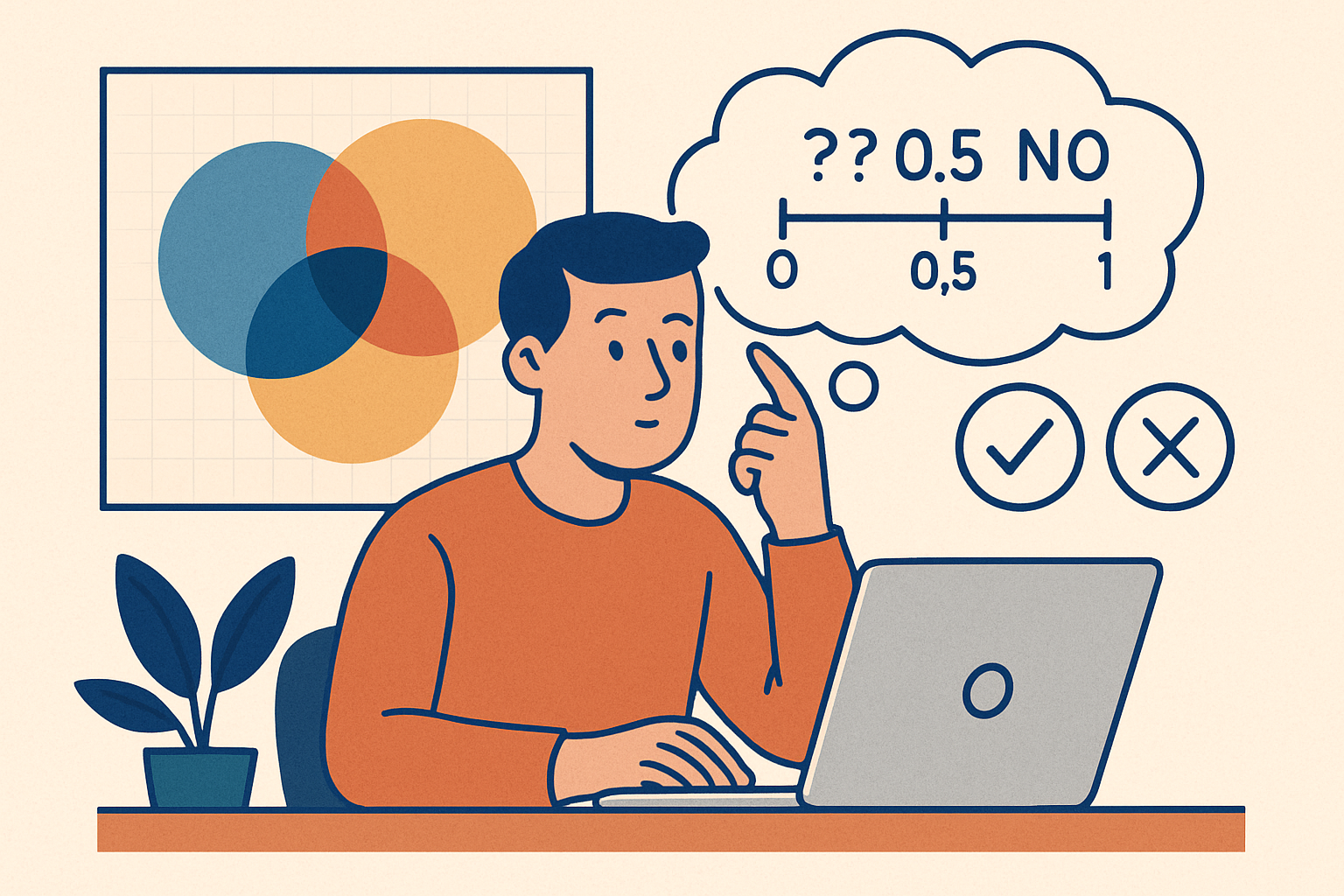
Ever notice how most choices aren’t yes or no? You’re not just “tired” or “awake,” your shower isn’t only “hot” or “cold.” Real life lives in the in-between. Flores-Parra and colleagues present a simple way to model fuzziness, allowing non-experts to build smarter simulations in NetLogo, a free tool that many students already use. Their idea is to plug in fuzzy logic—rules that accept shades of meaning—so digital “agents” make choices more like people do.

Here’s the core idea in plain terms. A fuzzy inference system is a set of everyday IF-THEN rules that turn inputs into decisions. Think: IF the room is “a bit warm” AND my budget is “low,” THEN set the fan to “medium.” In their toolkit, you name your inputs and outputs, define what words like “low,” “medium,” and “high” mean (those are membership functions), write a few rules, and then test the results on real numbers to see the decision the system makes. There are two flavors: Type-1 (great when things are fairly clear) and Type-2 (better when there’s extra uncertainty, like noisy sensors or vague opinions). The toolkit guides you through inputs, outputs, membership functions, rules, and evaluation, so you don’t get overwhelmed by the math.

You can build these rules by hand or let data suggest them. The team shows both paths. In a classic NetLogo voting model, they add a fuzzy rule so that each patch “prefers” blue or green depending on nearby votes—much like a friend is swayed by the vibe of their group, rather than just a strict majority. Then they flip to data-driven mode: using census information from Tijuana, they cluster neighborhoods and auto-generate fuzzy rules that classify agents as Catholic or non-Catholic, then watch how people move if they don’t feel similar to neighbors. The cool part is that the toolkit exports a ready-to-use file you drop into NetLogo, so your agents can start making fuzzy decisions right away.

Why should you care? Because this is how many daily systems actually work. Apps can sort posts by “kind of relevant,” not only “relevant.” A fitness plan can adjust when your sleep is “so-so,” not purely “bad.” City planners can weigh “a little traffic” against “big safety gains.” Flores-Parra et al. point out uses in tech profiles, social and eco systems, health risk, planning, and even prices and markets. If you’re modeling anything—study habits, saving money, a club’s attendance—start with simple fuzzy rules you believe (“IF stress is high AND time is short THEN study in 25-minute sprints”), then, when you have data, let clustering refine those rules. Manual rules are easy to understand; data-mined rules can be truer to life. Mix both, test often, and remember: in real life, “a bit,” “mostly,” and “it depends” are features, not bugs.

Reference:
Flores-Parra, J. M., Castañón-Puga, M., Gaxiola-Pacheco, C., Palafox-Maestre, L. E., Rosales, R., & Tirado-Ramos, A. (2018). A Fuzzy Inference System and Data Mining Toolkit for Agent-Based Simulation in NetLogo. In Computer Science and Engineering Theory and Applications, Studies in Systems, Decision and Control (Vol. 143, pp. 127–149). https://doi.org/10.1007/978-3-319-74060-7_7

Privacy Notice & Disclaimer:
This blog provides simplified educational science content, created with the assistance of both humans and AI. It may omit technical details, is provided “as is,” and does not collect personal data beyond basic anonymous analytics. For full details, please see our Privacy Notice and Disclaimer. Read About This Blog & Attribution Note for AI-Generated Content to know more about this blog project.

From Taps to Talk: How Smart Exhibits Learn From You

When you visit a museum or use an app, you’re not just a spectator—you’re part of a conversation. Rosales et al. show that the quality of that conversation depends on a few simple things: Are you actually there and paying attention? Do you get to control anything? Do you receive feedback that helps you keep going? Can you adapt what you’re doing, be creative, or even “talk” back to the system? Those ideas—presence, interactivity, control, feedback, creativity, productivity, communication, and adaptation—can be observed and visualized to create a picture of how engaged you are. The goal is to use that picture to serve you better in the moment, not after the fact.

To make this practical, the authors describe six easy-to-grasp “levels” of interaction, ranging from simply being present (Level 0) to full-on back-and-forth interactions where you create, choose, adapt, and receive instant responses (Level 5). Imagine the difference between glancing at a welcome screen and actually steering what happens next. At the high end, you can pick what you see, change the order, give input, and get tailored replies—more like a game than a poster. Thinking in levels helps designers ask: what tiny tweak would move someone up one step—add a button, a hint, a quick “nice job,” or a way to choose the next challenge?

The team tested these ideas in a Mexican science museum called “El Trompo,” watching 500 visitors try a four-screen exhibit where you control a car, plane, bike, or balloon. Their system treated each exhibit and each visitor like “agents” that sense what’s happening and adjust the experience. Think of it as a low-key guide that notices if you’re lost, bored, or excited and then nudges the content—more instructions if you’re stuck, more freedom if you’re cruising. This isn’t sci-fi; it’s built with rules that translate fuzzy, human behavior into clear decisions about what to show you next.

What’s the practical takeaway for your everyday tech life? If you’re building a school project, a club website, or a small app, aim to lift people one level at a time. Offer quick feedback so they know a tap or swipe “worked.” Offer small choices so they feel in control, such as picking the next topic or difficulty level. Let them adapt the path, not just the pace. And if you’re the user, look for tools that “listen”—ones that react when you linger, explore, or ask for more. In the study, a learning approach called a neuro-fuzzy system performed the best in recognizing the level of people, which helped the system respond more accurately. In plain terms, the tech learned to read the room and act accordingly, which made the experience smoother and more enjoyable.

Reference:
Rosales, R., Castañón-Puga, M., Lara-Rosano, F., Flores-Parra, J. M., Evans, R., Osuna-Millan, N., & Gaxiola-Pacheco, C. (2018). Modelling the interaction levels in HCI using an intelligent hybrid system with interactive agents: A case study of an interactive museum exhibition module in Mexico. Applied Sciences (Switzerland), 8(3), 1–21. https://doi.org/10.3390/app8030446

Privacy Notice & Disclaimer:
This blog provides simplified educational science content, created with the assistance of both humans and AI. It may omit technical details, is provided “as is,” and does not collect personal data beyond basic anonymous analytics. For full details, please see our Privacy Notice and Disclaimer. Read About This Blog & Attribution Note for AI-Generated Content to know more about this blog project.

Why Flight Cancellations Don’t Have to Wreck Your Day (and What Networks Have to Do with It)

Think of a busy airport like a giant group chat: lots of people, many links, and constant messages. Parra et al. explain that systems like this are “complex” because they’re made of many simple parts that interact all the time—no single boss controls everything, but patterns still appear, a bit like ant colonies working together without a leader. That’s why a few airports seem “popular” hubs with tons of connections, while others are quieter. In a single-layer view of the European air network, some airports have over 100 direct links, so if one of those big hubs fails, the whole trip can fall apart.

Here’s the twist: life isn’t just one layer, and neither are airline routes. You might fly the same city pair with different airlines. A “multilayer” view treats each airline as its own layer. That matters because a problem in one layer (say, Airline A cancels) doesn’t kill the route if Airline B still flies it. Parra et al. show that in this multilayer setup, each layer has fewer connections than the all-in-one map, but that’s actually good for resilience—you can still switch layers to keep moving. In their example, one airline layer had 42 airports and 53 flights (20 of which were also flown by other airlines), and another had 44 airports and 55 flights (25 of which overlapped). Translation: backup options exist.

Now imagine your flight gets canceled. What happens next isn’t just luck—it can be modeled as a simple two-round “offer–counteroffer” chat between a passenger agent and an airline agent. Round one: you propose a fix; the airline accepts or rejects. Round two: the airline counters; you accept or reject. If no one agrees, you end up with a refund (the “conflict deal”). In their tests, many simulated passengers chose “fly tomorrow” over fighting it out, because it avoids the conflict outcome. In one airline layer, the average was about 27, choosing “tomorrow,” and 16 ending in conflict; in another, “tomorrow” averaged 27.6, and conflict 17.4. That sounds familiar: when travel gets messy, the practical win is often a simple reschedule.

So what’s useful for your day-to-day? First, know that big hubs really do matter—more links mean more ways through the system, but also bigger headaches if they go down. Second, check alternatives by airline, not just route; another “layer” might save your trip. Third, when a cancellation occurs, a quick and reasonable counteroffer (such as accepting next-day travel) can often work out better than digging in, because the other side is using a similar playbook and the clock is ticking. Parra et al. even note this approach can be extended to delays and connections later on, which is basically everything you care about when traveling. Understanding the network—and how simple negotiations unfold—helps you stay calm, select smart options quickly, and keep your plans on track.

Reference:
Parra, J., Gaxiola, C., & Castañón-Puga, M. (2018). Multi-layered Network Modeled with MAS and Network Theory. In Computer Science and Engineering Theory and Applications, Studies in Systems, Decision and Control (1st ed.). Springer. https://doi.org/10.1007/978-3-319-74060-7_6

Privacy Notice & Disclaimer:
This blog provides simplified educational science content, created with the assistance of both humans and AI. It may omit technical details, is provided “as is,” and does not collect personal data beyond basic anonymous analytics. For full details, please see our Privacy Notice and Disclaimer. Read About This Blog & Attribution Note for AI-Generated Content to know more about this blog project.

When Your Wi-Fi Argues with Itself (and Wins): How Smart Networks Keep Things Flowing

Imagine a city where traffic lights talk to each other. When one intersection becomes crowded, nearby lights adjust to keep cars moving. Raya et al. describe a network that behaves like that—except the “cars” are your video calls, game updates, and voice messages, and the “traffic lights” are tiny software agents that make quick decisions without waiting for a human. The idea is simple: detect when parts of the network are congested, then negotiate smarter routes so that the most important data gets through first. This self-managing style relies on four habits that every teen can recognize from life: setting yourself up, continually improving, addressing problems early, and protecting yourself. In network terms, these are referred to as self-configuration, self-optimization, self-repair, and self-protection.

To pull this off, the network sees itself as a web of “nodes” (devices) and “links” (connections). Some nodes are social butterflies with numerous connections; others are more reserved. By measuring who’s connected to whom and who sits in the “center” of things, the system spots the best places to send traffic when there’s trouble—think of texting a friend who knows everyone to spread the word fast. These ideas originate from graph theory, but you can visualize them as group chats and mutual connections: the more meaningful connections a node has, the more influence it holds in keeping the conversation moving.

Here’s the everyday win. When a device’s queue starts to overflow—like unread messages piling up—the system flags congestion and triggers a quick “vote” among nearby nodes about where to send each flow next. Flows get simple labels: video, voice, or data, each with a priority. The network then shares bandwidth based on that priority (for example, a higher share for top-priority traffic), so your voice call won’t stutter just because a background download got greedy. Only congested spots initiate this negotiation, and the choices aim to match each neighbor’s preferences and capacity, using straightforward rules such as first-in, first-out lines and a clear threshold for when to act. In short: notice the jam, ask the neighbors, and direct the flow where it will be treated most effectively.

The team built and tested this in a simulator to watch what happens over time. When parts of the network got crowded, the agents stepped in and rerouted traffic according to those priorities. Voice often came out ahead—useful when you care about smooth calls—while video and general data took turns depending on the situation. The big takeaway for daily life: smarter, fairer sharing means fewer glitches during the moments you actually notice, like streaming or chatting, while quieter tasks adapt in the background. It’s like having a friend group that instinctively gives the mic to whoever needs it most, then rotates it back. This approach makes networks more resilient and hands-off, allowing them to keep up with whatever you throw at them—without requiring you to think about it.

Reference:
K. Raya-Díaz, C. Gaxiola-Pacheco, & M. Castañón-Puga. (2018). Agent-Based Model for Self-Management of Network Flows using Negotiation. IEEE LATIN AMERICA TRANSACTIONS, 16(1), 204–209. https://doi.org/10.1109/TLA.2018.8291475

Privacy Notice & Disclaimer:
This blog provides simplified educational science content, created with the assistance of both humans and AI. It may omit technical details, is provided “as is,” and does not collect personal data beyond basic anonymous analytics. For full details, please see our Privacy Notice and Disclaimer. Read About This Blog & Attribution Note for AI-Generated Content to know more about this blog project.