Order, Chaos, and Why “The Edge” Isn’t Always Best

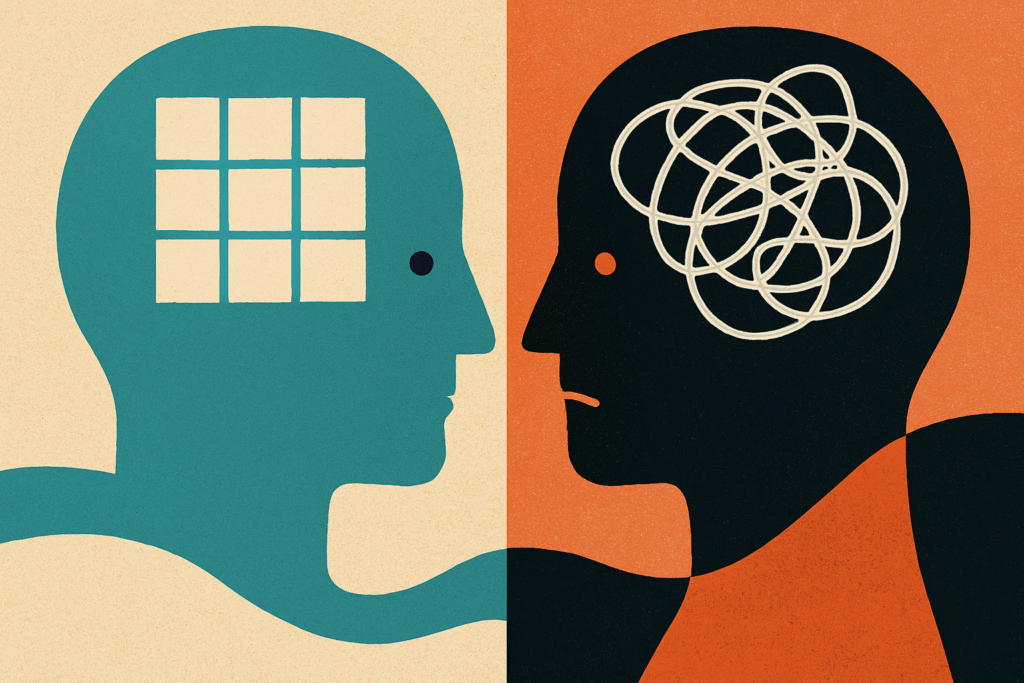
Imagine you and your friends are trying to agree on pizza toppings in a group chat. If everyone shouts at once, nothing gets decided. If everyone stays silent, nothing changes either. The sweet spot feels like a chat where messages flow, people react, and a clear choice emerges. For years, some scientists thought the best “thinking” machines work the same way—right at the line between total order and total chaos. Mitchell, Hraber, and Crutchfield took a hard look at that idea and found the story is more complicated than the slogan. 

Their work revisits two classics: Langton’s lambda (a knob that counts how many “1” outputs a rule produces) and Packard’s experiment evolving simple grid worlds—cellular automata—to do a job: decide whether a starting pattern has more 1s than 0s, then flip the entire grid to all 1s or all 0s accordingly. Think of it like a super-fast group vote that must end in a clear yes or no. The “edge of chaos” idea says the best rules should live near special lambda values where behavior shifts from tidy to wild. Packard reported clustering near those “critical” zones. The new study explains lambda, the phase-style behavior it was meant to summarize, and how Packard set up his genetic algorithm to test rule generation after generation. 

Here’s the twist. A well-known rule (the GKL rule) often solves the task by sending out little “signals” that spread until the whole grid agrees—like ripples that settle a debate. But it only does so approximately, and its lambda is smack in the middle at 1/2, not near the supposed critical edges. The authors also show why good rules for this job naturally hover near 1/2: the task is perfectly balanced between 0 and 1, so drifting far from 1/2 makes mistakes more likely. In their own evolution runs, populations were pulled toward 1/2 by simple combinatorics (“drift”) and then split to either side as new strategies emerged—a symmetry breaking that shaped progress. That’s a big reason their results didn’t back the “edge” claim. 

Why should you care? Because it serves as a reminder to be cautious with catchy rules of thumb. The authors demonstrate that what appears to be recipe (“always operate at the edge”) may actually reflect the task at hand and the way success is measured may be universal. In everyday life, that means: don’t assume the most exciting, high-noise setting—more apps, more tabs, more chats—is where you think best. Sometimes the winning setup is balanced, not extreme. It also means symmetry and biases matter: if your decision rule quietly favors one side, you may keep landing on the wrong choice. Test ideas against varied cases, not just the ones that flatter them. That’s the deeper lesson of their study: useful computation grows from clear goals, fair tests, and smart strategies—not from chasing an edgy vibe.

Reference:
Mitchell, M., Hraber, P. T., & Crutchfleld, J. P. (1993). Revisiting the Edge of Chaos: Evolving Cellular Automata to Perform Computations. Complex Systems7(2), 89–130. https://doi.org/10.48550/arXiv.adap-org/9303003.

Privacy Notice & Disclaimer:
This blog provides simplified educational science content, created with the assistance of both humans and AI. It may omit technical details, is provided “as is,” and does not collect personal data beyond basic anonymous analytics. For full details, please see our Privacy Notice and Disclaimer. Read About This Blog & Attribution Note for AI-Generated Content to know more about this blog project.


How We Actually Make Good Decisions (and Why the Bar Gets Crowded)

You’ve checked Maps and your favorite café looks “busy.” Should you go anyway? You text a friend: “Last Thursday it was packed, so today might be fine.” That’s you doing what most of us do when things are uncertain. Not perfect math. Just pattern-spotting and a best guess. Economist W. Brian Arthur says that expecting people to use flawless, step-by-step logic in real life is unrealistic, especially when situations become complicated or when other people’s choices continually shift the game. In messy problems, strict logic runs out of road, and we fall back on simpler ways of thinking. We look for patterns, try a plan, see how it goes, and adjust. That’s normal, not lazy. It’s how humans cope when full information and crystal-clear rules aren’t available.

Arthur calls this inductive reasoning. Think of it like building little “if-this-then-that” mini-models in your head. You notice a pattern, form a quick hypothesis, act on it, and then update based on feedback. Chess players do this all the time: they spot familiar shapes on the board, guess what the opponent is aiming for, test a few moves in their head, and then keep or ditch their plan depending on what happens next. We do the same in everyday life—studying, dating, and job hunting. We try something that worked before, keep score in our minds, and switch tactics when it stops paying off. It’s learning on the fly, not waiting for the “perfect” answer that rarely exists in the wild.

To illustrate this, Arthur shares a simple story: a bar with 100 potential customers. It’s fun only if fewer than 60 show up. Nobody can know attendance for sure. Each person looks at past weeks and uses a small rule to predict next week: “same as last week,” “average of the last four,” “two-week cycle,” and so on. If your rule says it won’t be crowded, you go; if it says it will, you stay home. No secret coordination. Just lots of small, private guesses. Now the cool part: across time, people’s rules “learn,” and the whole crowd stabilizes around an average of 60—yet the specific rules people rely on keep changing. It’s like a forest with a stable shape but trees that come and go. Expectations can’t all match because if everyone believes “it’ll be empty,” then everyone goes and it’s crowded; if everyone believes “it’ll be packed,” no one goes and it’s empty. As a result, people end up holding different views, and the mix keeps things balanced.

Why should you care? Because life is that bar. Group projects, trending restaurants, sneaker drops, and even pricing a side hustle—all are moving targets shaped by other people’s guesses. Arthur’s point is practical: don’t wait for perfect logic. Build simple rules from real signals, keep track of what works, and be prepared to adjust strategies when they stop delivering results. Small, adaptable rules often outperform rigid “one true plan” in social settings that are constantly evolving. That’s how markets, negotiations, poker nights, and product launches often behave—cycling through temporary patterns instead of settling into one eternal formula. Use patterns, measure results, and iterate. That’s not second-best thinking. It’s the kind that actually wins when everyone else is also deciding at the same time.

Reference:
Arthur, W. B. (1994). Inductive Reasoning and Bounded Rationality. Papers and Proceedings of the Hundred and Sixth Annual Meeting of the American Economic Association, 84(2), 406–411. https://www.jstor.org/stable/2117868

Privacy Notice & Disclaimer:
This blog provides simplified educational science content, created with the assistance of both humans and AI. It may omit technical details, is provided “as is,” and does not collect personal data beyond basic anonymous analytics. For full details, please see our Privacy Notice and Disclaimer. Read About This Blog & Attribution Note for AI-Generated Content to know more about this blog project.
When Your Model Isn’t Big Enough: How We Learn to See Hidden Patterns

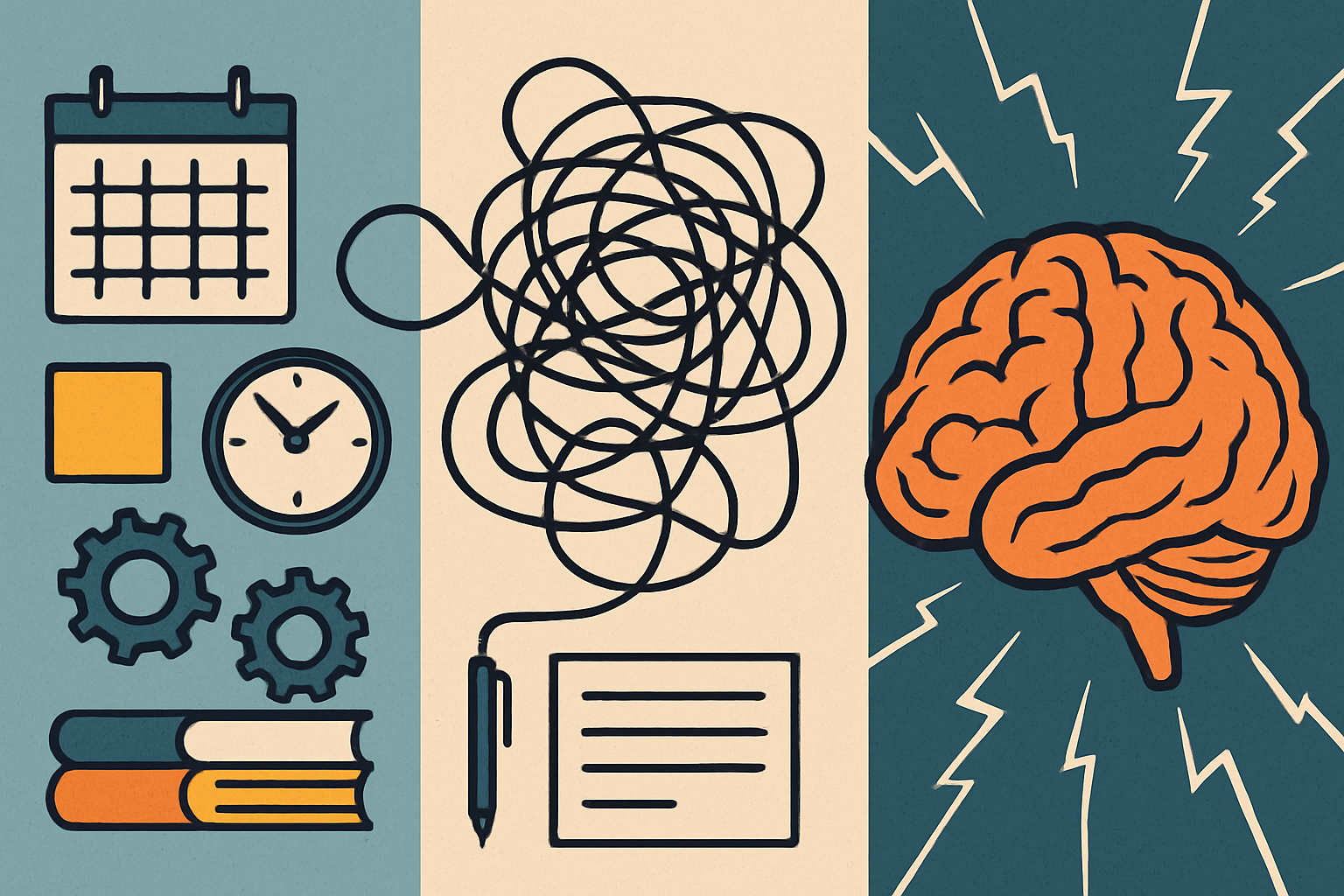
Picture you trying to make sense of a messy playlist. At first, you just note each song. Soon, you group them by mood. Then you realize there’s a deeper rule: the same three vibes always cycle, just in different lengths. You didn’t change the music. You changed how you looked at it. James P. Crutchfield describes this shift as “innovation” in how we model the world. When our current way of organizing data runs out of steam, we jump to a new, more capable way of seeing cause and effect. That jump, not more data alone, is what reveals the structure that felt like noise a moment ago.

Crutchfield’s method, called hierarchical ε-machine reconstruction, climbs a ladder of models, starting with the raw stream, then moving to trees, and finally to finite automata, and, if necessary, to richer machines. Try the simplest class first; if the model continues to grow as you feed it more data, that’s your cue to “innovate” and move up a level. The goal is the smallest model at the least powerful level that still captures the regularities, because small, right-sized models predict best. Think of it like upgrading from sorting songs one by one to folders, to smart playlists that automatically recognize patterns. The process continues until your model remains finite and predictive.

When should you upgrade? Crutchfield offers a simple rule of thumb: innovate once your model’s size reaches the point where it pushes against your own capacity. He even defines an “innovation rate” to identify when complexity is escalating as you refine the fit. If you ignore that signal, you’ll mistake lawful structure for random chatter. Real examples make this vivid. At the edge of chaos in a classic system, a naive model explodes into infinitely many states; the fix is to innovate a new representation that uses a stack-like memory, turning the “infinite” into a tidy finite description. And sometimes the opposite lesson hits: use the wrong instrument, and even a simple world looks impossibly complex. The remedy is to innovate the sensor model itself—say, by adding a counter that tracks how long you’ve seen the same symbol—so your description shrinks back to size.

Why does this matter day to day? Because we all model. Studying, budgeting, training, even scrolling—each is a guess about “what comes next.” Crutchfield shows that progress comes from knowing when to keep it simple and when to change the game. If your study notes become bloated without boosting recall, consider switching from lists to concept maps. If your workout tracker can’t spot plateaus, add a new feature like moving averages—a small “counter” that changes what you can see. If a chaotic group chat looks unreadable, filter for themes—your “domain and particle” view—to reveal structure under the noise. The big idea is practical: organize your limited attention into smarter models and be ready to innovate when your current one reaches its limits. That’s how hidden order shows up, prediction improves, and “random” turns into patterns you can actually use.

Reference:
Crutchfield, J. P. (1994). The calculi of emergence: computation, dynamics and induction. Physica D: Nonlinear Phenomena75(1–3), 11–54. https://doi.org/10.1016/0167-2789(94)90273-9

Privacy Notice & Disclaimer:
This blog provides simplified educational science content, created with the assistance of both humans and AI. It may omit technical details, is provided “as is,” and does not collect personal data beyond basic anonymous analytics. For full details, please see our Privacy Notice and Disclaimer. Read About This Blog & Attribution Note for AI-Generated Content to know more about this blog project.
Order, Chaos, and How Your Brain Actually Gets Things Done

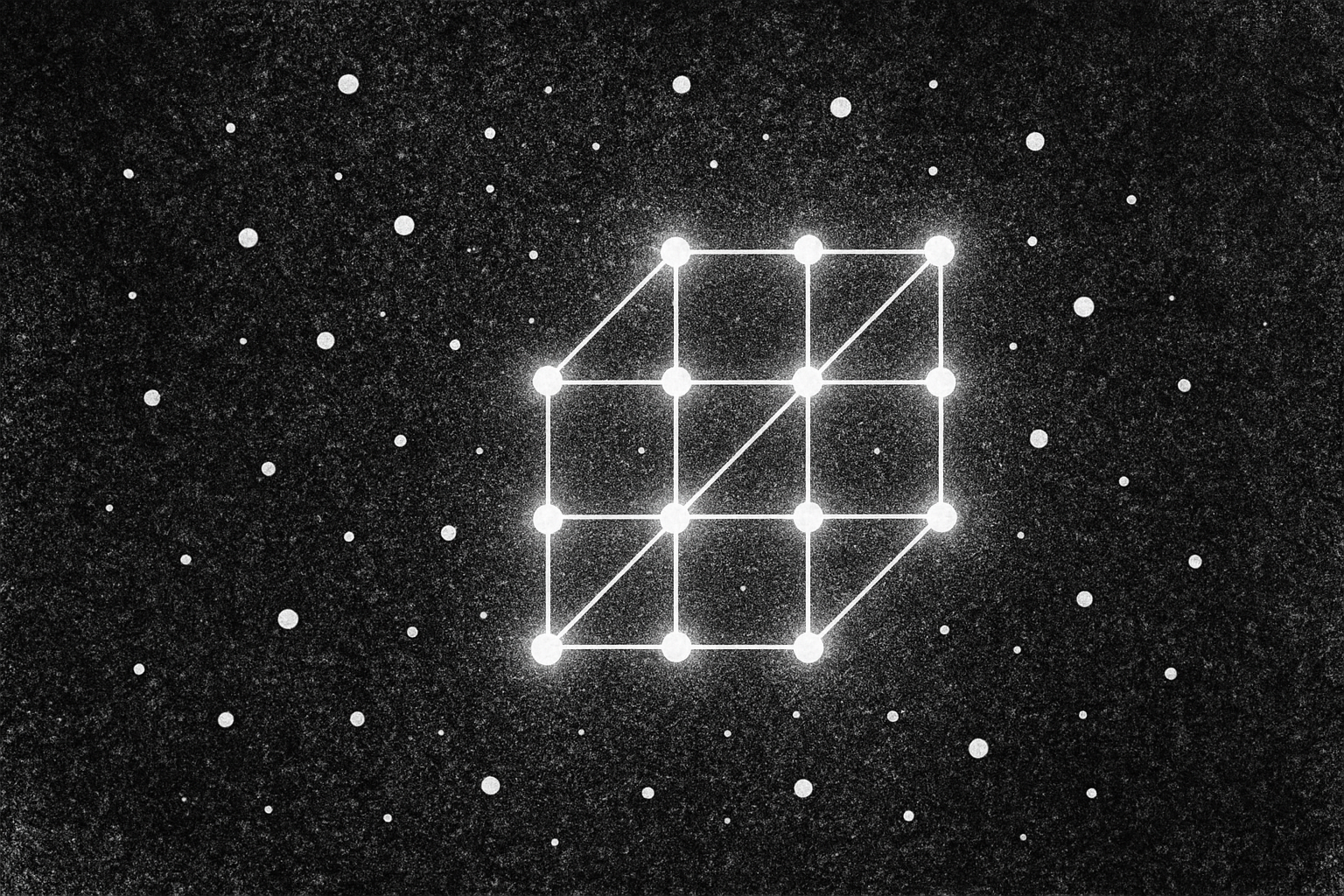
Picture a day when your phone won’t stop buzzing. Group chats are wild. Your notes app is neat. Your feed feels random, but your calendar is strict. You bounce between noise and plan. It turns out real progress lives in that mix. As Crutchfield puts it, neither pure order nor pure randomness is enough for anything truly complex to appear; both play a role in a larger process. And there’s a reason your life needs both: stability helps you store information, while a bit of instability helps you create and communicate new ideas. That trade-off is the heart of nontrivial information processing.

Crutchfield uses language as an everyday example. We speak in a way that’s both useful and informative, yet structured enough to be easily understood. That tension is what lets meanings build on top of each other. So you don’t need to live at an “edge of chaos” to be smart or creative; high capability doesn’t require hovering near chaos at all. Think about texting a friend: a few emojis, a meme, and a clear plan for later. It’s part surprise, part structure. That blend keeps the chat fun and still useful—exactly the balance that makes complex systems work.

Crutchfield also offers a practical way to think about “emergence.” Something really new has emerged when the way you process information changes enough to unlock a new level of ability that wasn’t there before. This isn’t about piling on more observations from the outside; it’s about building the change into the process itself so the new structure has its own internal meaning and use. How do you get there? Through three everyday moves: modeling—making a simple mental picture of what’s going on; computation—using your limited time and memory to predict and act; and innovation—finding a smarter way to organize those same limits. Switching from scattered notes to a tight “one-page” system, or from endless scrolling to a timed-block routine, isn’t just a habit tweak. It’s a new information-processing architecture.

Finally, why does this keep happening in life and in nature? Because our resources are always limited. That pressure nudges us to invent better internal models and climb to the next level of skill. In Crutchfield’s view, this “evolutionary mechanics” is open-ended: we continually move forward by making small innovations that utilize our existing resources more effectively. So if your day feels like a dance between noise and order, that’s not a bug. It’s the engine. Use stable routines to store what matters, let a bit of randomness spark new ideas, and redesign your system when you hit a wall. That’s how complexity—and real progress—emerges.

Reference:
Crutchfield, J. P. (1994). The calculi of emergence: computation, dynamics and induction. Physica D: Nonlinear Phenomena75(1–3), 11–54. https://doi.org/10.1016/0167-2789(94)90273-9

Privacy Notice & Disclaimer:
This blog provides simplified educational science content, created with the assistance of both humans and AI. It may omit technical details, is provided “as is,” and does not collect personal data beyond basic anonymous analytics. For full details, please see our Privacy Notice and Disclaimer. Read About This Blog & Attribution Note for AI-Generated Content to know more about this blog project.

Seeing Hidden Order in a Noisy World

You’re scrolling through your phone, jumping from texts to videos to homework. Some things feel random. Some things feel predictable. Yet you still try to guess what comes next — the plot twist, the next notification, the teacher’s quiz question. Crutchfield argues that this everyday guessing game mirrors how scientists build models: they try to capture the useful patterns and treat the rest as “noise,” balancing simple explanations with good predictions instead of chasing either alone. In practice, the “best” model is the one that minimizes both the model’s size and the leftover randomness.

According to Crutchfield, what makes something truly interesting isn’t just pure order or pure randomness, but the mix in between. He describes “statistical complexity,” a method for measuring the amount of structure a process possesses. Purely random and perfectly periodic signals are actually simple by this measure; the richest structure lives between those extremes, where predictable and unpredictable pieces interact. Imagine a playlist that’s not totally shuffled and not a loop — it feels “designed” because it has memory and variation. That’s where complexity peaks.

Here’s the twist that helps in real life: systems can create patterns that the system itself then uses. Crutchfield calls this “intrinsic emergence.” Think of prices in a marketplace or trending topics online. They don’t come from one boss; they emerge from everyone’s actions and then guide what everyone does next. In this view, something “emerges” when the way information is processed changes — when the system gains new internal capability, not just a new look from the outside. That’s different from simply spotting a pretty pattern after the fact.

So, how do we improve at spotting and utilizing structure? Crutchfield’s answer is to build the simplest model that still predicts well, then upgrade only when the current approach continues to grow without limit. His framework, based on reconstructing minimal “machines,” treats model size as the memory you need to make good forecasts; when your model bloats, you “innovate” to a new class that captures the pattern more cleanly. In everyday terms: don’t memorize every detail of a course, a habit, or a feed; learn the few states that actually matter for predicting what comes next — and when that stops working, change how you’re thinking, not just how much you’re cramming.

Reference:
Crutchfield, J. P. (1994). The calculi of emergence: computation, dynamics and induction. Physica D: Nonlinear Phenomena, 75(1–3), 11–54. https://doi.org/10.1016/0167-2789(94)90273-9

Privacy Notice & Disclaimer:
This blog provides simplified educational science content, created with the assistance of both humans and AI. It may omit technical details, is provided “as is,” and does not collect personal data beyond basic anonymous analytics. For full details, please see our Privacy Notice and Disclaimer. Read About This Blog & Attribution Note for AI-Generated Content to know more about this blog project.